
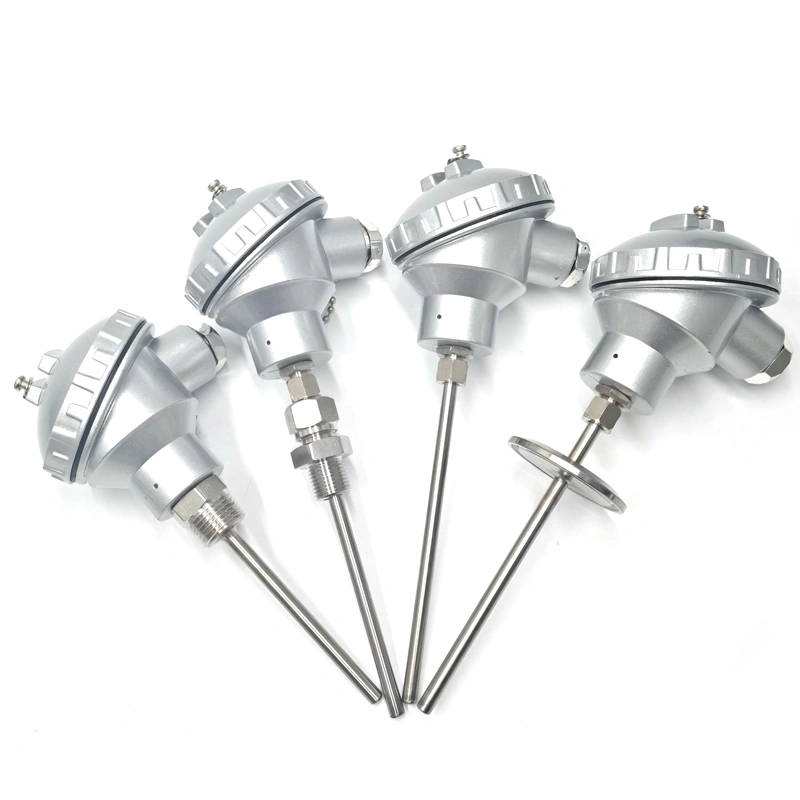
Type K Thermocouples in Kenya
| Specification | Details |
|---|---|
| Product Name | Type K Thermocouple |
| Product Category | Temperature Sensor |
| Thermocouple Type | K |
| Positive Conductor | Chromel |
| Negative Conductor | Alumel |
| Measurement Principle | Thermoelectric / Seebeck Effect |
| Nominal Sensitivity | Approx. 41 µV/°C around room temperature |
| Standard Reference Range | Approx. −200°C to +1260°C, standard dependent |
| Practical Probe Range | Construction dependent |
| Probe Diameter | Multiple options |
| Probe Length | Multiple options |
| Sheath Material | Stainless steel / heat-resistant alloy, product dependent |
| Junction Options | Grounded / Ungrounded / Exposed |
| Mounting | Thread / Bayonet / Compression / Surface / Probe |
| Cable Length | Multiple options |
| Output | Millivolt signal |
| Application | Industrial temperature measurement |
Description
Type K Thermocouples in Kenya | Sanvil Industries Ltd
Type K Thermocouples provide reliable temperature measurement across a wide range of industrial processes. Common applications include furnaces, ovens, boilers, kilns, heating elements, plastics machinery, packaging machines, food-processing equipment, HVAC systems, generators, industrial machinery, and process-control systems. Their broad temperature range, practical durability, and compatibility with many industrial temperature controllers make them a versatile choice for temperature monitoring and control.
At Sanvil Industries Ltd, we stock quality Type K Thermocouples in Kenya in different probe lengths, probe diameters, cable lengths, mounting configurations, and connection styles. Our range can include threaded probes, bayonet thermocouples, flexible probes, surface sensors, mineral-insulated probes, and high-temperature assemblies. We serve customers across Kenya, Uganda, and Tanzania at competitive wholesale and bulk prices.
Product Description – Type K thermocouples
A Type K thermocouple is a thermoelectric temperature sensor that uses two different conductor alloys:
- Positive conductor: Chromel — primarily nickel-chromium alloy
- Negative conductor: Alumel — primarily nickel-aluminium alloy
When the sensing junction experiences a temperature difference from the reference junction, the two conductors generate a small thermoelectric voltage. A compatible controller, indicator, transmitter, PLC module, or data logger interprets this voltage as temperature.
Type K is one of the most common thermocouple types because it combines a wide temperature range, good general-purpose performance, relatively fast response, and broad instrument compatibility.
However, the actual operating temperature range depends on the wire diameter, probe construction, sheath material, insulation, junction configuration, atmosphere, and manufacturer specification.
How a Type K Thermocouple Works
The operating principle is straightforward:
Temperature at sensing junction → Thermoelectric voltage → Controller/indicator → Temperature reading
The Type K junction produces a small voltage according to the temperature difference between the sensing point and reference point.
Modern temperature controllers normally provide cold-junction compensation, allowing the instrument to calculate the process temperature from the thermocouple signal.
Because the output is in millivolts, correct sensor type, wiring, polarity, and extension cable are important for reliable measurements.
Common Type K Thermocouple Designs
| Design | Typical Application |
|---|---|
| Threaded Probe | Pipes, tanks, machinery and process equipment |
| Bayonet Type | Plastics machinery and heater assemblies |
| Flexible Probe | Machinery and difficult installation points |
| Mineral-Insulated Probe | Industrial and higher-temperature processes |
| Surface Sensor | Pipes, plates and equipment surfaces |
| Ring Type | Surface and equipment monitoring |
| High-Temperature Probe | Furnaces, kilns and heat-treatment systems |
| Head Type | Industrial process installations |
| Exposed Junction | Fast-response temperature measurement |
Applications of Type K thermocouples
1. Industrial Furnaces
Type K sensors monitor furnace temperatures and provide feedback to compatible temperature-control systems.
2. Industrial Ovens
Ovens for drying, curing, baking, and manufacturing processes use these sensors for temperature monitoring and control.
3. Boilers
Suitable probe assemblies can monitor temperatures at appropriate points in boiler and heating systems.
4. Plastics Machinery
Injection moulding machines and extruders commonly use Type K probes around barrels, nozzles, dies, and heater zones.
5. Heating Elements
Thermocouples provide temperature feedback to controllers that regulate industrial heaters.
6. Kilns
Suitable high-temperature probe assemblies monitor ceramic, heat-treatment, and other kiln processes.
7. Food-Processing Machinery
Suitable stainless-steel probes monitor temperature in ovens, dryers, processing equipment, tanks, and production machinery.
8. HVAC Systems
Type K sensors can monitor suitable air, duct, equipment, and process temperatures.
9. Packaging Machinery
Heat-sealing and packaging equipment can use Type K sensors to monitor heater and sealing temperatures.
10. Industrial Process Control
Factories use Type K sensors with controllers, PLC systems, indicators, transmitters, and data-acquisition equipment.
Key Features & Benefits of Type K thermocouples
1. Broad Temperature Range
Type K provides a wide measurement range for many industrial heating and process applications.
2. General-Purpose Industrial Performance
The sensor works well across a broad selection of machinery, heating, manufacturing, and process applications.
3. Multiple Probe Configurations
Threaded, bayonet, flexible, mineral-insulated, surface, and high-temperature options support different installation requirements.
4. Fast Response Options
Small-diameter and exposed-junction designs can provide rapid response where the application permits.
5. Good Instrument Compatibility
Many industrial temperature controllers and indicators support Type K input.
6. Multiple Probe Sizes
Different diameters and lengths allow installation in machinery, pipes, tanks, ovens, furnaces, and process equipment.
7. Durable Construction Options
Stainless steel and specialized sheath materials provide protection for the sensing element in suitable environments.
8. Competitive Pricing & Reliable Stock
Sanvil Industries Ltd offers competitive wholesale and bulk prices with dependable supply throughout East Africa.
Common Probe Diameters and Lengths
Type K probes come in many configurations. Common probe diameters can include:
- 1.5 mm
- 2 mm
- 3 mm
- 4 mm
- 5 mm
- 6 mm
- 8 mm
- 10 mm
- 12 mm
Common probe lengths can include:
- 50 mm
- 100 mm
- 150 mm
- 200 mm
- 250 mm
- 300 mm
- 500 mm
- 600 mm
- 1000 mm
Custom dimensions may also be available.
When requesting a quotation, provide the probe diameter × probe length together with the mounting connection and cable length.
Threaded Type K Thermocouples
Threaded thermocouples provide secure installation into suitable machinery, tanks, pipes, heating equipment, and process systems.
Common connection sizes can include:
- 1/8″
- 1/4″
- 3/8″
- 1/2″
- M6
- M8
- M10
- M12
- M14
- M16
Availability varies according to sensor design.
The thread standard must also match the installation. For example, an inch-size connection may use BSP, BSPT, NPT, or another thread form.
Bayonet Type K Thermocouples
Bayonet thermocouples are particularly common in:
- Injection moulding machines
- Extruders
- Plastics-processing equipment
- Packaging machinery
- Heater blocks
- Industrial machines
A spring and bayonet arrangement helps maintain sensor contact while providing some adjustment in insertion depth.
Mineral-Insulated Type K Thermocouples
Mineral-insulated (MI) thermocouples use compacted mineral insulation around the conductors within a metallic sheath.
They can offer:
- Small probe diameters
- Good mechanical protection
- Flexible probe options
- Fast thermal response
- Broad industrial temperature capability
Actual performance depends on sheath alloy, probe diameter, junction design, and process conditions.
Grounded vs Ungrounded vs Exposed Junction
| Junction | Response | Electrical Isolation | Protection |
|---|---|---|---|
| Grounded | Fast | Lower | Good |
| Ungrounded | Moderate | Better | Good |
| Exposed | Very fast | Application dependent | Lower |
Grounded Junction
The sensing junction has thermal contact with the probe sheath. This generally improves response speed.
Ungrounded Junction
The sensing junction remains electrically isolated from the sheath. This configuration can help where electrical isolation is important.
Exposed Junction
The sensing junction sits directly in the process environment, giving fast response but less mechanical protection.
Type K vs Type J Thermocouple
| Feature | Type K | Type J |
|---|---|---|
| Positive Conductor | Chromel | Iron |
| Negative Conductor | Alumel | Constantan |
| General Temperature Range | Wider | More limited |
| General Industrial Use | Very common | Common |
| High-Temperature Capability | Generally higher | Generally lower |
| Oxidation Resistance | Generally better | Iron conductor requires consideration |
| Plastics Machinery | Common | Common |
| Furnaces | Common with suitable construction | Application dependent |
Type K Thermocouple vs PT100
| Feature | Type K | PT100 |
|---|---|---|
| Sensor Principle | Thermoelectric voltage | Resistance |
| Output | Millivolts | Resistance |
| Nominal Resistance | N/A | 100 Ω at 0°C |
| Temperature Range | Very broad | Broad |
| Very High Temperature | Better with suitable construction | More limited |
| Accuracy | System dependent | Often high |
| Response | Can be very fast | Probe dependent |
| Extension Cable | Type K compatible | Copper wiring, system dependent |
| Industrial Heating | Excellent | Excellent |
The correct choice depends on temperature range, accuracy requirements, process conditions, controller input, and installation.
Type K Extension Cable
The thermocouple signal is very small, so the correct cable system matters.
When extending a Type K circuit, use compatible Type K thermocouple or extension-grade cable according to the measurement-system requirements.
Ordinary copper cable should not automatically replace the correct extension cable because introducing different metals into the measurement circuit can create additional thermoelectric junctions and measurement errors.
Also check polarity throughout the circuit.
Type K Thermocouple Colour Codes
Thermocouple wire colours can vary according to the standard.
Common standards include:
- IEC
- ANSI
- BS
- DIN
- JIS
Therefore, never identify Type K polarity from colour alone unless you know which standard applies to the cable.
Check the cable markings, connector markings, manufacturer data, and controller terminals.
Connecting Type K to a Temperature Controller
A typical system can follow this arrangement:
Type K Thermocouple → Temperature Controller → SSR/Contactor → Heating Element
The thermocouple provides the temperature signal. The controller compares the measured temperature with the target value and operates the appropriate output device.
For correct operation:
- Set the controller input to Type K.
- Connect the positive and negative conductors to the correct terminals.
- Use compatible extension cable where necessary.
- Keep sensor wiring away from high-current power cables where practical.
- Check that the probe temperature capability matches the application.
Type K Thermocouple Technical Data Sheet
| Parameter | Typical Information |
|---|---|
| Thermocouple Type | K |
| Positive Material | Chromel |
| Negative Material | Alumel |
| Measurement Principle | Seebeck effect |
| Output | Millivolt |
| Nominal Sensitivity | Approx. 41 µV/°C near room temperature |
| Standard Reference Range | Approx. −200°C to +1260°C, standard dependent |
| Probe Diameter | Multiple options |
| Probe Length | Multiple options |
| Junction | Grounded / Ungrounded / Exposed |
| Sheath | Stainless steel / specialized alloy |
| Mounting | Thread / Bayonet / Compression / Surface |
| Cable Length | Multiple options |
| Instrument Input | Type K |
| Application | Industrial temperature measurement |
How to Choose the Correct Type K Thermocouple
Confirm the Maximum Temperature
The complete probe assembly must handle the process temperature, not merely the theoretical Type K range.
Choose the Probe Diameter
Smaller probes can offer faster response, while larger probes can provide greater mechanical strength.
Select the Probe Length
Choose enough insertion length to reach the correct measurement zone.
Confirm the Thread
For threaded probes, provide the connection size and thread standard.
Select the Junction Type
Choose grounded, ungrounded, or exposed according to response speed, electrical isolation, and process conditions.
Check the Sheath Material
Temperature, corrosion, oxidation, and process atmosphere influence sheath selection.
Specify the Cable Length
Measure the distance from the probe to the controller or connection point.
Confirm Controller Compatibility
The controller must support Type K input.
Why Choose Sanvil Industries Ltd
Wide Type K Range
Our range can include threaded probes, bayonet sensors, flexible probes, mineral-insulated options, surface sensors, and high-temperature configurations.
Multiple Probe Sizes
Customers can choose different diameters and lengths for machinery, furnaces, ovens, tanks, pipes, and heating equipment.
Multiple Connection Options
Threaded, bayonet, compression, surface, and other mounting configurations support diverse industrial installations.
Temperature Control Accessories
Our range can include temperature controllers, heating elements, cables, contactors, relays, and other industrial control accessories.
Competitive Wholesale Pricing
We offer competitive prices for factories, technicians, machine builders, contractors, institutions, laboratories, and distributors.
Technical Selection Support
For a quotation, provide the Type K requirement, temperature range, probe diameter, probe length, thread size, cable length, junction type, and application.
Regional Distribution
We serve customers throughout Kenya, Uganda, Tanzania, and other East African markets.
Bulk Order Support
Sanvil Industries Ltd handles bulk requirements for factories, maintenance teams, contractors, machine builders, institutions, and distributors.
Safety & Installation
Select the sensor according to the process temperature, atmosphere, pressure, probe material, junction configuration, mounting system, and controller input.
Confirm that the controller input is Type K before connection.
Observe correct polarity.
Use compatible thermocouple or extension cable when additional cable length is necessary.
Protect sensor cables from excessive heat, sharp edges, crushing, moisture, and high-current electrical wiring.
Avoid unnecessary junctions between dissimilar wire materials.
For furnaces, boilers, pressure systems, hazardous areas, and critical processes, ensure the complete sensor assembly matches the applicable engineering and safety requirements.
FAQs
Q1. What is a Type K thermocouple?
A: Type K is a temperature sensor with Chromel and Alumel conductors. It generates a small voltage according to temperature.
Q2. What temperature range can Type K measure?
A: Standard Type K reference tables cover a very broad range, but the practical limit depends on probe construction, wire size, sheath, insulation, and process conditions.
Q3. Can Type K work in a furnace?
A: Yes. A suitable Type K probe can work in many furnace applications when its sheath and complete construction match the process temperature and atmosphere.
Q4. Can Type K work with a temperature controller?
A: Yes. The controller must support Type K input and have the correct sensor configuration.
Q5. What probe lengths do you have?
A: Our range can include short and long probes for machinery, ovens, furnaces, pipes, tanks, and process equipment. Provide the diameter and length you need for a quotation.
Q6. Do you have Type K sensors with a thread?
A: Yes. Our range can include various thread sizes and mounting styles. Confirm the thread size and standard before purchase.
Q7. What is the difference between Type K and Type J?
A: Type K uses Chromel and Alumel, while Type J uses iron and Constantan. Type K generally offers a broader temperature range.
Q8. Can I extend a Type K cable?
A: Yes. Use a compatible Type K thermocouple or extension cable and maintain correct polarity throughout the circuit.
Q9. Can I buy Type K thermocouples in bulk?
A: Yes. Sanvil Industries Ltd handles bulk orders for factories, contractors, machine builders, technicians, institutions, and distributors.
Q10. Which countries can Sanvil Industries Ltd deliver Type K thermocouples to?
A: We serve customers across Kenya, Uganda, Tanzania, and other East African markets.
Contact Us
For quotations or bulk orders in Kenya, Uganda, and Tanzania, contact Sanvil Industries Ltd for competitive prices and fast delivery.
Sanvil Industries Ltd
📍 Location: Industrial Area, Nairobi, Kenya
📞 Phone: +254 722343016
📧 Email: sanvilindustries@gmail.com


Reviews
There are no reviews yet.