
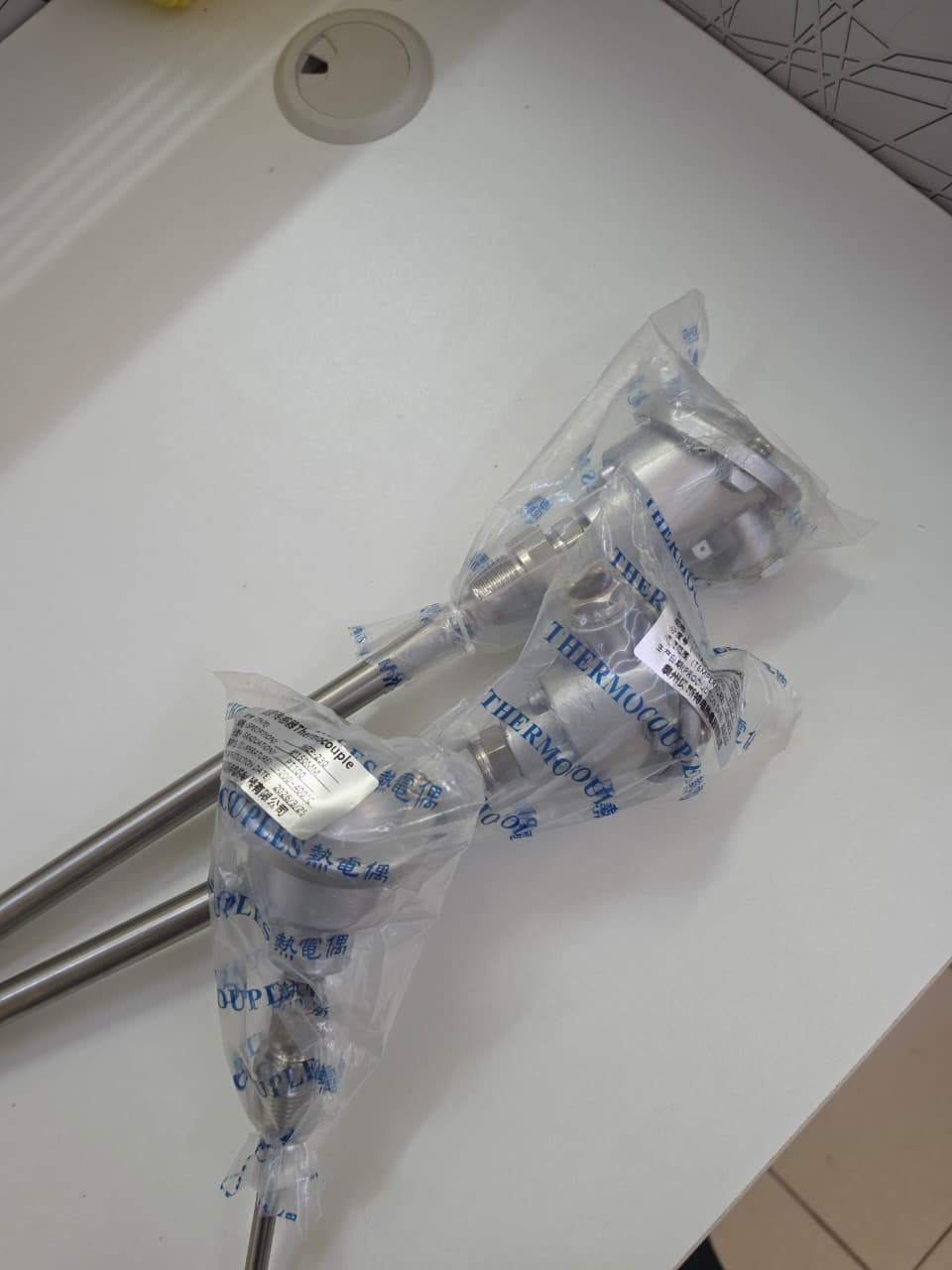
PT100 Temperature Sensors in Kenya
| Specification | Details |
|---|---|
| Product Name | PT100 Temperature Sensor |
| Sensor Category | RTD |
| Sensing Material | Platinum |
| Nominal Resistance | 100 Ω at 0°C |
| Common Standard | IEC 60751 |
| Common Wiring | 2-Wire / 3-Wire / 4-Wire |
| Temperature Range | Probe construction dependent |
| Probe Material | Stainless steel / specialized sheath |
| Probe Diameter | Multiple options |
| Probe Length | Multiple options |
| Mounting | Thread / Compression / Probe / Head Type |
| Cable Length | Multiple options |
| Output Principle | Resistance change |
| Controller Input | PT100 / RTD compatible |
| Application | Precision industrial temperature measurement |
Description
PT100 Temperature Sensors in Kenya | Sanvil Industries Ltd
PT100 Temperature Sensors are precision Resistance Temperature Detectors (RTDs) for accurate temperature measurement in boilers, ovens, industrial machinery, tanks, food-processing equipment, HVAC systems, laboratories, water systems, chemical plants, pharmaceutical equipment, heating systems, and process-control applications. They offer excellent stability and accuracy across a broad industrial temperature range.
At Sanvil Industries Ltd, we stock quality PT100 Temperature Sensors in Kenya in different probe lengths, diameters, cable lengths, thread sizes, and connection configurations. Our range can include 2-wire, 3-wire, and 4-wire PT100 probes, threaded sensors, head-type RTDs, flexible cable probes, and stainless-steel probe assemblies. We serve customers across Kenya, Uganda, and Tanzania at competitive wholesale and bulk prices.
Product Description – PT100 Temperature Sensors
The name PT100 describes the sensor’s basic characteristics:
PT = Platinum
100 = 100 ohms (Ω) at 0°C
As temperature changes, the electrical resistance of the platinum sensing element changes in a predictable manner. A compatible temperature controller, transmitter, PLC input, indicator, or data-acquisition system measures this resistance and converts it into a temperature value.
For a common IEC 60751 PT100 element, resistance increases to approximately 138.5 Ω at 100°C.
PT100 sensors are popular where applications need good accuracy, repeatability, stability, and reliable process-temperature measurement.
How PT100 Sensors Works
A PT100 relies on the predictable relationship between platinum resistance and temperature.
At:
0°C → 100 Ω
For a standard IEC 60751 sensor with α = 0.00385 Ω/Ω/°C, the resistance near 0°C changes by approximately:
0.385 Ω per °C
At 100°C, the resistance is approximately:
138.5 Ω
The basic measurement chain is:
PT100 Probe → Resistance Signal → Controller/Transmitter → Temperature Reading
Unlike a thermocouple, the PT100 does not rely on a junction of two different metals to generate a millivolt signal.
Common PT100 Configurations
| Configuration | Main Characteristic |
|---|---|
| 2-Wire PT100 | Simple wiring |
| 3-Wire PT100 | Compensates for lead resistance in common industrial systems |
| 4-Wire PT100 | Offers high measurement accuracy |
| Threaded PT100 | Easy mounting into tanks, pipes and machinery |
| Head-Type PT100 | Industrial terminal-head configuration |
| Cable Probe PT100 | Compact probe with flexible cable |
| Surface PT100 | Surface-temperature measurement |
| High-Temperature PT100 | Special construction for higher-temperature service |
2-Wire PT100
A 2-wire sensor provides the simplest RTD connection.
However, the resistance of the connecting wires becomes part of the measurement circuit. This can introduce measurement error, particularly where the cable is long or very high accuracy is necessary.
It can suit applications where simplicity and shorter cable runs are more important than maximum measurement precision.
3-Wire PT100
The 3-wire PT100 is one of the most common configurations in industrial temperature-control systems.
A compatible instrument uses the third conductor to compensate for much of the lead-wire resistance, assuming suitable lead conditions.
Common applications include:
- Industrial machinery
- Tanks
- Boilers
- HVAC equipment
- Food-processing machinery
- Water systems
- Manufacturing equipment
- Process-control systems
For many industrial installations, 3-wire provides a practical balance between accuracy, wiring complexity, and cost.
4-Wire PT100
A 4-wire configuration provides a more precise method of compensating for lead resistance.
It is particularly useful in:
- Laboratories
- Calibration systems
- Precision process measurement
- Test equipment
- Research facilities
- High-accuracy industrial systems
The instrument measures the sensing element in a way that minimizes the effect of lead resistance.
Applications of PT100 Temperature Sensors
1. Industrial Boilers
Suitable PT100 probes monitor temperature at appropriate points within boiler and heating systems.
2. Food Processing
Stainless-steel probe assemblies suit many food-processing machines, tanks, heating systems, and production processes.
3. HVAC Systems
RTD probes monitor air, water, equipment, and process temperatures within compatible HVAC installations.
4. Water Treatment
PT100 sensors provide accurate temperature measurement in suitable water-treatment and process-water systems.
5. Chemical Processing
Compatible probe materials can monitor temperatures in tanks, pipes, reactors, and other process equipment.
6. Pharmaceutical Equipment
The accuracy and stability of platinum RTDs make them useful in suitable pharmaceutical and process applications.
7. Industrial Machinery
Factories use these sensors for machinery, tanks, bearings, process equipment, heating systems, and production lines.
8. Laboratories
PT100 sensors support test equipment, experiments, calibration systems, and precision temperature measurement.
9. Cold Rooms & Refrigeration
Suitable probes can monitor air, product, pipe, and equipment temperatures in refrigeration and cold-storage systems.
10. Heating Systems
PT100 probes provide temperature feedback to compatible controllers in industrial heating applications.
Key Features & Benefits of PT100 Temperature Sensors
1. High Measurement Accuracy
PT100 technology provides excellent temperature accuracy when the sensor and instrument match the application requirements.
2. Good Long-Term Stability
Platinum offers stable and predictable resistance characteristics for industrial temperature measurement.
3. Excellent Repeatability
PT100 sensors provide consistent measurements across repeated temperature cycles within their design limits.
4. Multiple Wiring Options
2-wire, 3-wire, and 4-wire configurations support different accuracy and installation requirements.
5. Wide Probe Selection
Different diameters, lengths, mounting connections, and sheath materials suit diverse industrial systems.
6. Strong Controller Compatibility
Many industrial temperature controllers, PLC modules, transmitters, and indicators offer PT100 input.
7. Stainless-Steel Probe Options
Suitable stainless-steel sheaths provide corrosion resistance and mechanical protection.
8. Competitive Pricing & Reliable Stock
Sanvil Industries Ltd offers competitive wholesale and bulk prices with dependable supply throughout East Africa.
PT100 vs Type K Thermocouple
| Feature | PT100 RTD | Type K Thermocouple |
|---|---|---|
| Sensor Type | RTD | Thermocouple |
| Sensing Principle | Resistance change | Thermoelectric voltage |
| Sensing Material | Platinum | Chromel / Alumel |
| Value at 0°C | 100 Ω | Millivolt output |
| Accuracy | Generally high | Application dependent |
| Stability | Excellent | Good |
| Very High Temperature | More limited | Better |
| Common Wiring | 2 / 3 / 4 wire | Positive / negative |
| Extension Wiring | RTD circuit | Type K compatible cable |
| Industrial Use | Very common | Very common |
For moderate industrial temperatures where accuracy and stability are priorities, PT100 can be an excellent option.
For very high temperatures or applications that require a particularly broad measurement range, a suitable thermocouple can offer advantages.
PT100 vs PT1000
| Feature | PT100 | PT1000 |
|---|---|---|
| Resistance at 0°C | 100 Ω | 1000 Ω |
| Sensing Material | Platinum | Platinum |
| Principle | RTD | RTD |
| Lead Resistance Effect | More significant | Relatively smaller |
| Industrial Use | Extremely common | Common |
| Controller Input | Must support PT100 | Must support PT1000 |
PT100 Accuracy Classes
IEC 60751 defines different tolerance classes for platinum RTDs. Common references include Class A and Class B, while higher-accuracy categories can also appear in suitable sensor specifications.
In general:
| Class | General Characteristic |
|---|---|
| Class A | Tighter tolerance |
| Class B | Common industrial tolerance |
| Higher-Precision Options | Application and manufacturer dependent |
The complete measurement accuracy also depends on the probe assembly, wiring, transmitter, controller, calibration, installation, and process conditions.
Common Probe Diameters & Lengths
- 3 mm
- 4 mm
- 5 mm
- 6 mm
- 8 mm
- 10 mm
- 12 mm
Common lengths can include:
- 50 mm
- 100 mm
- 150 mm
- 200 mm
- 250 mm
- 300 mm
- 500 mm
- 600 mm
- 1000 mm
Other dimensions may be available according to project requirements.
For quotations, provide the probe diameter × probe length, together with thread size, cable length, wiring configuration, and temperature range.
Threaded PT100 Sensors
Threaded probes provide secure installation into:
- Tanks
- Pipes
- Boilers
- Machinery
- Water systems
- Process equipment
- Heating systems
Common connection references can include:
- 1/8″
- 1/4″
- 3/8″
- 1/2″
- M8
- M10
- M12
- M14
- M16
The exact connection should match the installation.
For inch threads, also confirm whether the system requires BSP, BSPT, NPT, or another thread standard.
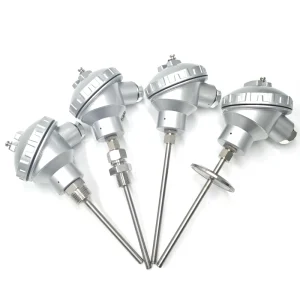
PT100 Head-Type Sensors
Head-type RTDs provide a robust industrial configuration for process plants, tanks, pipelines, machinery, and manufacturing systems.
The terminal head provides space for electrical connections and, in some configurations, a temperature transmitter.
A typical arrangement can be:
PT100 Element → Terminal Head → Temperature Transmitter → 4–20 mA → PLC/Controller
The exact system depends on the instrument and process design.
Connecting PT100 to a Temperature Controller
The controller must have a compatible PT100/RTD input.
A basic system can be:
PT100 Sensor → Temperature Controller → SSR/Contactor → Heating Element
Before connection, confirm:
- PT100 input on controller
- 2-wire, 3-wire, or 4-wire configuration
- Correct controller terminals
- Temperature range
- Probe specification
- Cable requirements
Do not configure a PT100 as Type K. The two sensors operate on completely different electrical principles.
Technical Data Sheet (TDS)
| Parameter | Typical Information |
|---|---|
| Product | PT100 Temperature Sensor |
| Sensor Type | Platinum RTD |
| Nominal Resistance | 100 Ω at 0°C |
| Common Standard | IEC 60751 |
| Temperature Coefficient | Commonly α = 0.00385 Ω/Ω/°C |
| Wiring | 2 / 3 / 4 wire |
| Probe Diameter | Multiple options |
| Probe Length | Multiple options |
| Sheath | Stainless steel / specialized material |
| Mounting | Thread / Compression / Probe / Head |
| Cable Length | Multiple options |
| Accuracy Class | Product dependent |
| Controller Input | PT100 / RTD |
| Application | Industrial temperature measurement |
How to Choose the Correct PT100
Confirm the Temperature Range
Determine the lowest and highest process temperatures before choosing the probe construction.
Choose 2, 3 or 4 Wires
For general industrial applications, 3-wire is common. Precision applications may benefit from 4-wire configurations.
Select the Probe Diameter
Consider response time, mechanical strength, insertion space, and process conditions.
Choose the Probe Length
The probe should reach the correct temperature measurement point.
Confirm the Thread Size
For threaded sensors, check both connection size and thread standard.
Select the Sheath Material
Choose the probe sheath according to temperature, corrosion, chemicals, pressure, and process environment.
Confirm Cable Length
Measure the distance between the probe and controller, transmitter, or junction point.
Check Controller Input
Make sure the instrument specifically supports PT100 RTD input.
Why Choose Sanvil Industries Ltd
Multiple PT100 Configurations
Our range can include 2-wire, 3-wire, 4-wire, threaded, cable-probe, and head-type options.
Different Probe Sizes
Customers can choose various probe diameters and lengths for tanks, pipes, machinery, boilers, HVAC equipment, and process systems.
Multiple Connection Options
Threaded, compression, cable, and industrial head configurations support diverse installation requirements.
Temperature Control Accessories
Our range can include temperature controllers, heating elements, contactors, relays, transmitters, and other industrial control components.
Competitive Wholesale Pricing
We offer competitive prices for factories, technicians, contractors, laboratories, institutions, machine builders, and distributors.
Technical Selection Support
For a quotation, provide the temperature range, 2/3/4-wire configuration, probe diameter, probe length, thread size, cable length, and application.
Regional Distribution
We serve customers throughout Kenya, Uganda, Tanzania, and other East African markets.
Bulk Order Support
Sanvil Industries Ltd handles bulk requirements for factories, maintenance teams, contractors, institutions, laboratories, and distributors.
Safety & Installation
Confirm that the controller or transmitter supports PT100 RTD input before connection.
Select the probe according to process temperature, pressure, fluid, sheath material, and environmental conditions.
Use the correct 2-wire, 3-wire, or 4-wire terminal configuration.
Protect sensor cables from excessive heat, mechanical damage, moisture, and electrical interference.
Place the sensing section where it can represent the actual process temperature.
For boilers, pressure vessels, chemical plants, hazardous areas, and critical processes, ensure the complete sensor assembly meets the applicable engineering requirements.
FAQs
Q1. Is PT100 a thermocouple?
A: No. PT100 is an RTD with a platinum sensing element. A thermocouple uses two different conductor materials and produces a thermoelectric voltage.
Q2. What does PT100 mean?
A: “PT” refers to platinum, while “100” refers to a nominal resistance of 100 ohms at 0°C.
Q3. What resistance does PT100 have at 100°C?
A: A common IEC 60751 PT100 has a resistance of about 138.5 ohms at 100°C.
Q4. What is the difference between 2-wire and 3-wire PT100?
A: A 3-wire circuit helps the instrument compensate for lead resistance, while a 2-wire circuit has a simpler connection.
Q5. What is a 4-wire PT100?
A: A 4-wire arrangement provides excellent compensation for lead resistance and suits precision temperature measurement.
Q6. Can PT100 work with a temperature controller?
A: Yes. The controller must have a PT100 or RTD input and match the sensor wiring configuration.
Q7. What is the difference between PT100 and Type K?
A: PT100 measures temperature through platinum resistance, while Type K generates a thermoelectric voltage from Chromel and Alumel conductors.
Q8. Do you have PT100 sensors with a thread?
A: Yes. Our range can include multiple thread sizes and probe configurations for pipes, tanks, machinery, and process equipment.
Q9. Can I buy PT100 sensors in bulk?
A: Yes. Sanvil Industries Ltd handles bulk orders for factories, contractors, laboratories, institutions, technicians, and distributors.
Q10. Which countries can Sanvil Industries Ltd deliver PT100 sensors to?
A: We serve customers across Kenya, Uganda, Tanzania, and other East African markets.
Contact Us
For quotations or bulk orders in Kenya, Uganda, and Tanzania, contact Sanvil Industries Ltd for competitive prices and fast delivery.
Sanvil Industries Ltd
📍 Location: Industrial Area, Nairobi, Kenya
📞 Phone: +254 722343016
📧 Email: sanvilindustries@gmail.com

Reviews
There are no reviews yet.