
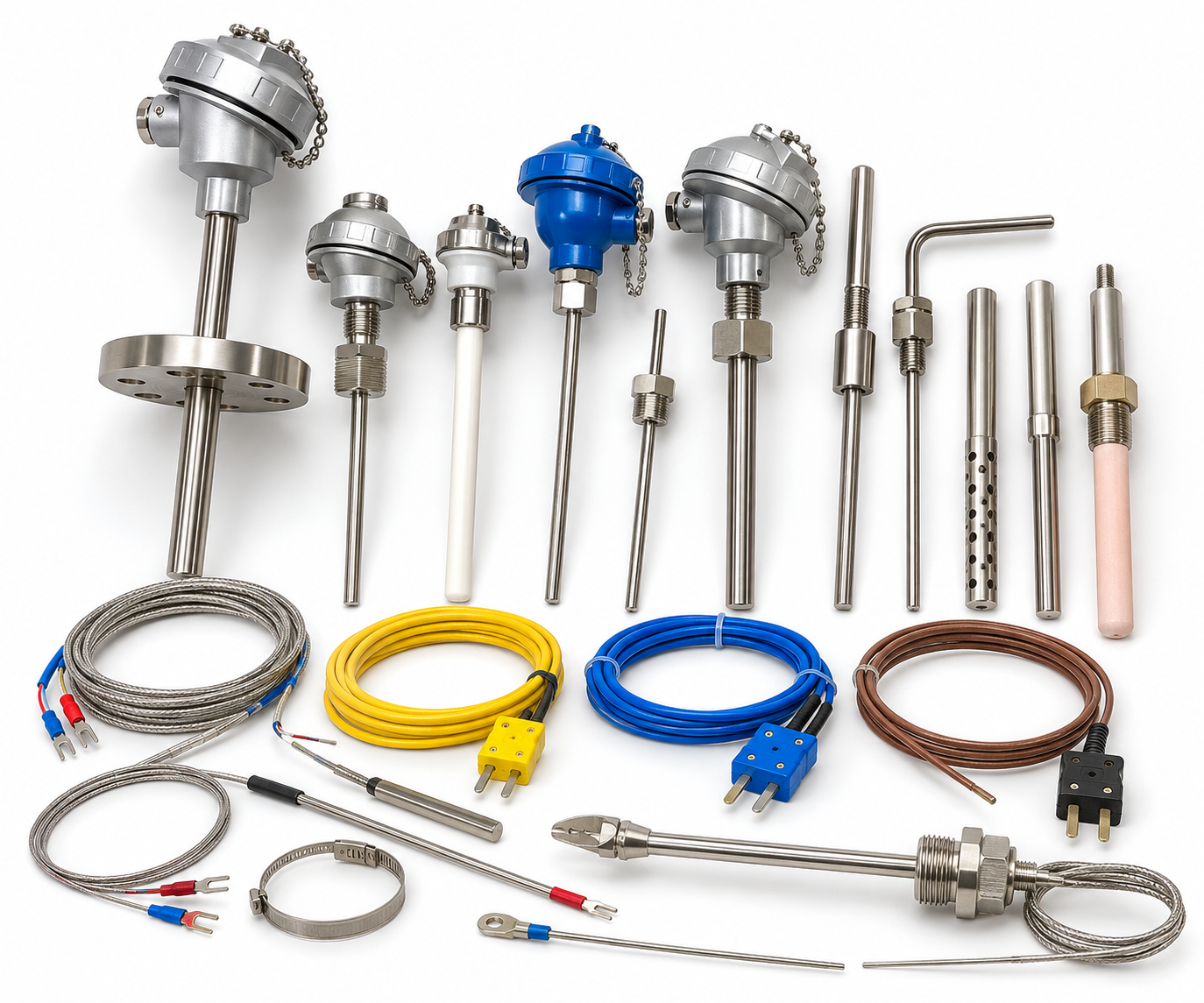
Thermocouples in Kenya
| Specification | Details |
|---|---|
| Product Name | Thermocouple |
| Product Type | Temperature Sensor |
| Measurement Principle | Thermoelectric / Seebeck effect |
| Common Types | K / J / T / E / N / R / S / B |
| Common Industrial Options | Type K / Type J |
| Probe Material | Stainless steel / alloy sheath, product dependent |
| Probe Diameter | Multiple options |
| Probe Length | Multiple options |
| Connection | Thread / Bayonet / Flange / Probe / other |
| Cable Length | Multiple options |
| Junction Type | Exposed / Grounded / Ungrounded, product dependent |
| Temperature Range | Thermocouple type and construction dependent |
| Output | Millivolt signal |
| Controller Compatibility | Input type must match sensor type |
| Application | Industrial temperature measurement |
Description
Thermocouples in Kenya | Sanvil Industries Ltd
Thermocouples are industrial temperature sensors that measure temperature in boilers, furnaces, ovens, kilns, heating systems, manufacturing machinery, plastics equipment, food-processing plants, laboratories, HVAC systems, and process industries. They offer a practical solution for temperature monitoring and control across both moderate and high-temperature applications.
At Sanvil Industries Ltd, we stock quality Thermocouples in Kenya, including common Type K, Type J, and other sensor configurations for industrial and commercial applications. Options can include probe thermocouples, threaded sensors, flexible probes, bayonet types, surface sensors, and high-temperature assemblies. We serve customers across Kenya, Uganda, and Tanzania at competitive wholesale and bulk prices.
Product Description – thermocouples
A thermocouple measures temperature through the Seebeck effect. Two conductors of different metals form a sensing junction. When this junction experiences a temperature difference relative to the reference point, it produces a small voltage that temperature-control equipment can interpret.
Thermocouples work with compatible temperature controllers, PLC systems, indicators, data loggers, transmitters, and industrial control panels.
Different thermocouple types use different alloy combinations and therefore offer different temperature ranges, sensitivities, and environmental characteristics.
Type K is one of the most common choices for general industrial temperature measurement. Type J also appears widely in machinery and industrial heating applications. Other types include T, E, N, R, S, and B, depending on the temperature range and process requirements.
For accurate selection, customers should confirm the thermocouple type, temperature range, probe diameter, probe length, connection thread, cable length, sheath material, and controller input.
Common Thermocouple Types
| Type | Typical Alloy Pair | General Characteristics |
|---|---|---|
| Type K | Chromel / Alumel | Broad general-purpose industrial range |
| Type J | Iron / Constantan | Common in machinery and industrial heating |
| Type T | Copper / Constantan | Useful for lower-temperature applications |
| Type E | Chromel / Constantan | High thermoelectric output |
| Type N | Nicrosil / Nisil | Good stability for demanding temperature service |
| Type R | Platinum-Rhodium / Platinum | Very high-temperature measurement |
| Type S | Platinum-Rhodium / Platinum | High-temperature laboratory and industrial service |
| Type B | Platinum-Rhodium alloys | Very high-temperature applications |
Actual operating limits depend on wire diameter, insulation, sheath material, atmosphere, probe construction, and manufacturer specification.
Type K Thermocouples
Type K is among the most common thermocouple choices for general industrial temperature measurement.
It uses Chromel and Alumel conductors and provides a broad temperature range for suitable applications.
Common applications include:
- Industrial ovens
- Furnaces
- Boilers
- Heating equipment
- Plastics machinery
- Packaging equipment
- Food-processing machinery
- HVAC equipment
- Process plants
- General industrial temperature control
Type K sensors come in many probe diameters, lengths, cable configurations, and mounting styles.
Type J Thermocouples
They use iron and constantan conductors. It is common in many industrial heating and machinery applications.
Typical applications include:
- Industrial machinery
- Heating equipment
- Plastics processing
- Ovens
- Packaging machinery
- Process equipment
- Temperature-control systems
The iron conductor can limit suitability in certain oxidizing or moisture-rich environments at elevated temperatures, so application conditions remain important.
Applications of thermocouples
1. Industrial Furnaces
Thermocouples monitor furnace temperature and provide signals to compatible temperature-control systems.
2. Boilers
Suitable probes can monitor temperatures at appropriate points within boiler and heating installations.
3. Industrial Ovens
Temperature sensors help maintain process conditions in baking, curing, drying, and heat-treatment equipment.
4. Plastics Machinery
Injection moulding machines, extruders, and other plastics equipment use thermocouples to monitor barrel, nozzle, and heater temperatures.
5. Food Processing
Suitable sensor assemblies monitor temperatures in ovens, dryers, processing machinery, tanks, and production equipment.
6. Heating Elements
Thermocouples work alongside heaters and controllers to provide temperature feedback within heating systems.
7. HVAC Systems
Suitable sensors monitor air, duct, equipment, and process temperatures in HVAC applications.
8. Kilns
High-temperature thermocouple types monitor ceramic, heat-treatment, and other kiln processes.
9. Manufacturing Machinery
Factories use temperature sensors in production lines, machines, tanks, moulds, dryers, and processing equipment.
10. Laboratories
Suitable thermocouples provide temperature measurement for laboratory equipment, test rigs, and experimental systems.
Key Features & Benefits of thermocouples
1. Wide Temperature Capability
Different thermocouple types cover a broad range of industrial temperatures.
2. Fast Temperature Response
Suitable probe designs can react quickly to changes in process temperature.
3. Multiple Sensor Types
Type K, J, T, E, N, R, S, and B options allow selection according to application requirements.
4. Multiple Probe Sizes
Different diameters and lengths support machinery, tanks, pipes, ovens, furnaces, and process equipment.
5. Simple Electrical Output
Thermocouples generate a small thermoelectric voltage that compatible instruments interpret as temperature.
6. Industrial Durability
Suitable sheath and probe constructions provide strong performance in demanding industrial environments.
7. Broad Equipment Compatibility
Thermocouples work with compatible controllers, indicators, transmitters, PLC modules, and data-acquisition systems.
8. Competitive Pricing & Reliable Stock
Sanvil Industries Ltd offers competitive wholesale and bulk prices for factories, contractors, technicians, institutions, and industrial customers.
Common Thermocouple Probe Designs
Threaded Probe Thermocouples
A threaded connection allows installation into tanks, pipes, machinery, heating systems, and process equipment.
Bayonet Thermocouples
Bayonet-style sensors are common in plastics machinery and applications that require adjustable insertion depth and spring pressure.
Flexible Thermocouples
Flexible probe or cable designs allow installation where rigid sensors may be impractical.
Surface Thermocouples
Surface sensors measure the temperature of suitable pipes, plates, machinery, and equipment surfaces.
High-Temperature Thermocouples
Special sheath materials and thermocouple types provide temperature measurement in furnaces, kilns, heat-treatment systems, and other high-temperature processes.
Grounded vs Ungrounded vs Exposed Junction
| Junction Type | General Characteristic |
|---|---|
| Grounded | Fast response with junction in thermal contact with sheath |
| Ungrounded | Electrical isolation between junction and sheath |
| Exposed | Very fast response but less physical protection |
Thermocouple vs RTD
| Feature | Thermocouple | RTD |
|---|---|---|
| Measurement Principle | Thermoelectric voltage | Electrical resistance |
| Common Sensor Types | K, J, T, N, R, S | PT100 / PT1000 |
| Temperature Range | Very broad | Broad |
| Very High Temperature | Excellent with suitable type | More limited |
| Accuracy | Type and system dependent | Often high |
| Response | Often fast | Probe dependent |
| Signal | Millivolts | Resistance |
| Extension Cable | Thermocouple-specific | Copper instrument wiring, system dependent |
| Industrial Use | Very common | Very common |
Thermocouples Extension Cable
Thermocouple wiring requires careful selection because ordinary copper cable cannot automatically substitute for thermocouple or extension-grade cable.
The extension cable should match the thermocouple type and applicable temperature-measurement system.
For example, a Type K sensor requires a compatible Type K thermocouple or extension cable configuration.
Incorrect cable material, polarity, or connections can introduce measurement errors.
Thermocouple Polarity
Thermocouple circuits have positive and negative conductors. Correct polarity is essential for accurate temperature indication.
Wire colours can vary according to the applicable standard, so users should not rely on colour alone unless they know which colour code standard applies.
Check:
- Thermocouple type
- Positive conductor
- Negative conductor
- Connector markings
- Controller terminal markings
- Applicable colour-code standard
Connecting a Thermocouple to a Temperature Controller
A compatible temperature controller must have an input for the particular thermocouple type.
For example, when a Type K sensor connects to a controller, the controller input configuration should also indicate Type K.
The basic system is:
Thermocouple → Temperature Controller → Output Device → Heater or Process Equipment
The output side can control a suitable contactor, solid-state relay, alarm, PLC input, or other control component, depending on the system design.
Technical Data Sheet (TDS)
| Parameter | Typical Information |
|---|---|
| Product | Thermocouple Temperature Sensor |
| Sensor Types | K / J / T / E / N / R / S / B |
| Output | Millivolt |
| Probe Diameter | Multiple options |
| Probe Length | Multiple options |
| Sheath Material | Stainless steel / specialized alloy |
| Junction | Grounded / Ungrounded / Exposed |
| Mounting | Thread / Bayonet / Probe / Flange |
| Cable | Thermocouple / extension cable |
| Cable Length | Multiple options |
| Temperature Range | Sensor and construction dependent |
| Accuracy | Thermocouple class dependent |
| Connection | Bare wire / plug / terminal / head |
| Application | Industrial temperature measurement |
Choosing the Correct Thermocouple
Confirm the Thermocouple Type
Identify whether the controller or process requires Type K, J, T, N, R, S, or another sensor type.
Determine the Temperature Range
Select a sensor and sheath construction that can handle the minimum and maximum process temperatures.
Choose the Probe Diameter
Probe diameter affects mechanical strength and response characteristics.
Select the Probe Length
The probe should reach the correct measurement point without unnecessary insertion.
Confirm the Mounting Connection
Check whether the installation requires a threaded probe, bayonet connection, flange, compression fitting, surface sensor, or another mounting method.
Check the Thread Size
For threaded sensors, confirm both the nominal size and thread standard.
Select the Cable Length
Choose enough cable to reach the controller or junction point without unnecessary connections.
Check the Process Environment
Consider vibration, moisture, chemicals, pressure, abrasion, electrical interference, and atmosphere when selecting the probe.
Why Choose Sanvil Industries Ltd
Multiple Thermocouple Types
Our range can include Type K, Type J, and other temperature sensor options according to application requirements.
Different Probe Sizes
Customers can choose from various probe diameters and lengths depending on machinery and process requirements.
Multiple Mounting Options
Threaded, bayonet, flexible, surface, and other probe configurations can support different installations.
Temperature Control Accessories
Our range can include temperature controllers, heating elements, cables, contactors, relays, and other compatible control components.
Competitive Wholesale Pricing
We offer competitive prices for factories, technicians, contractors, laboratories, institutions, machine builders, and distributors.
Technical Selection Support
Customers can provide the thermocouple type, temperature range, probe diameter, probe length, thread size, cable length, and application for a more accurate quotation.
Regional Distribution
We serve customers throughout Kenya, Uganda, Tanzania, and other East African markets.
Bulk Order Support
Sanvil Industries Ltd handles bulk requirements for factories, machine builders, contractors, maintenance departments, institutions, and distributors.
Safety & Installation
Choose the thermocouple according to the temperature range, process atmosphere, pressure, probe material, junction type, controller input, and installation environment.
Ensure the temperature controller configuration matches the thermocouple type.
Observe correct polarity during wiring.
Use compatible thermocouple or extension cable where the measurement system requires it.
Avoid unnecessary cable joints because incorrect materials or connections can introduce measurement errors.
Protect cables from excessive heat, sharp edges, mechanical damage, moisture, and electrical interference.
For high-temperature furnaces, boilers, pressurized vessels, hazardous areas, and critical processes, ensure the complete sensor assembly meets the applicable engineering and safety requirements.
FAQs
Q1. What thermocouple types do you stock?
A: Our range can include Type K, Type J, and other thermocouple options for industrial temperature measurement.
Q2. What is a Type K thermocouple?
A: Type K uses Chromel and Alumel conductors and offers a broad temperature range for many industrial applications.
Q3. What is a Type J thermocouple?
A: Type J uses iron and constantan conductors and works well in many machinery, heating, oven, and industrial process applications.
Q4. Which thermocouple is best for a furnace?
A: The correct type depends on maximum temperature, furnace atmosphere, accuracy requirement, sheath material, and controller input. Type K, N, R, S, or other options can suit different furnace conditions.
Q5. Can a thermocouple work with a temperature controller?
A: Yes. The controller must support the thermocouple type and have the correct input configuration.
Q6. What is the difference between a thermocouple and PT100?
A: A thermocouple generates a small voltage from two different conductor materials, while a PT100 changes electrical resistance according to temperature.
Q7. Can I extend a thermocouple cable?
A: Yes, but the extension cable must match the thermocouple system. Incorrect cable material or polarity can cause temperature errors.
Q8. Which information should I provide when I need a thermocouple?
A: Provide the sensor type, temperature range, probe diameter, probe length, thread or mounting style, cable length, and application.
Q9. Can I buy thermocouples in bulk?
A: Yes. Sanvil Industries Ltd handles bulk orders for factories, machine builders, contractors, maintenance teams, institutions, and distributors.
Q10. Which countries can Sanvil Industries Ltd deliver thermocouples to?
A: We serve customers across Kenya, Uganda, Tanzania, and other East African markets.
Contact Us
For quotations or bulk orders in Kenya, Uganda, and Tanzania, contact Sanvil Industries Ltd for competitive prices and fast delivery.
Sanvil Industries Ltd
📍 Location: Industrial Area, Nairobi, Kenya
📞 Phone: +254 722343016
📧 Email: sanvilindustries@gmail.com


Reviews
There are no reviews yet.