
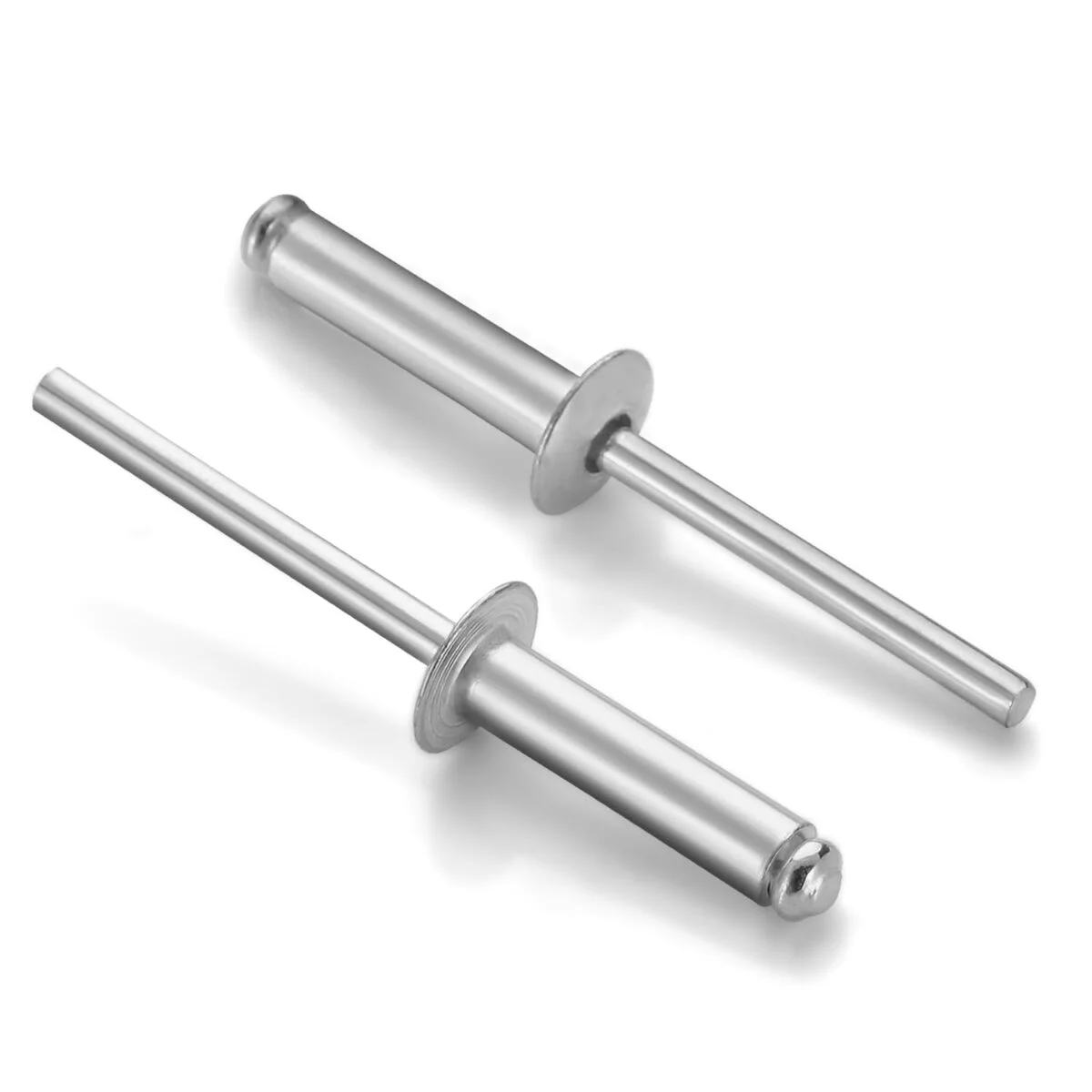
SS Rivets in Kenya
| Specification | Details |
|---|---|
| Product Name | SS Rivet |
| Full Name | Stainless Steel Rivet |
| Common Types | Blind / Pop / Solid / other |
| Body Material | Stainless Steel |
| Mandrel Material | Stainless / Steel, product dependent |
| Common Grades | SS304 / SS316, product dependent |
| Diameter | Multiple options |
| Length | Multiple options |
| Head Style | Dome / Large Flange / Countersunk / other |
| Installation | Hand, pneumatic, battery or hydraulic riveter |
| Joint Type | Permanent mechanical fastening |
| Corrosion Resistance | High, grade dependent |
| Applications | Sheet metal / HVAC / Fabrication / Industrial |
Description
SS Rivets in Kenya | Sanvil Industries Ltd
SS Rivets, also known as Stainless Steel Rivets, are corrosion-resistant mechanical fasteners for permanently joining two or more sheets, plates, panels, profiles, or fabricated components. They are widely applied in stainless steel fabrication, HVAC ducting, sheet-metal work, food-processing equipment, roofing, electrical panels, machinery, automotive fabrication, construction, and industrial maintenance.
At Sanvil Industries Ltd, we stock quality SS Rivets in Kenya in different diameters, lengths, head styles, and stainless-steel configurations. Our range can include stainless steel blind rivets, pop rivets, and solid rivets, depending on application and availability. We serve fabricators, contractors, HVAC technicians, factories, workshops, and industrial customers across Kenya, Uganda, and Tanzania at competitive wholesale and bulk prices.
Product Description – SS Rivets
A stainless steel rivet creates a permanent mechanical joint between compatible materials. Unlike a bolt and nut, many rivet systems do not require access to both sides of the workpiece during final installation.
Blind rivets, commonly called pop rivets, are particularly useful where an installer can reach only one side of the material.
A typical blind-rivet assembly consists of:
Rivet Body + Head + Mandrel
During installation, a rivet tool pulls the mandrel through the rivet body. The body expands on the blind side and clamps the materials together.
Stainless steel construction provides good corrosion resistance and mechanical performance for many industrial environments.
Common SS Rivets Sizes
Stainless steel blind rivets can come in diameters such as:
| Nominal Diameter | Approx. Inch Reference |
|---|---|
| 2.4 mm | 3/32″ |
| 3.0–3.2 mm | 1/8″ |
| 4.0 mm | 5/32″ |
| 4.8 mm | 3/16″ |
| 6.0–6.4 mm | 1/4″ |
Length options vary according to the material thickness and required grip range.
Actual dimensions should follow the manufacturer specification.
What Is Rivet Grip Range?
Grip range refers to the total material thickness that a particular blind rivet can clamp correctly.
For example:
Sheet 1 Thickness + Sheet 2 Thickness = Total Grip Thickness
The rivet must have a grip range that covers this total thickness.
A rivet that is too short may not form the correct joint. Meanwhile, excessive length can also affect joint quality.
Therefore, select rivets according to:
Diameter + Grip Range + Material + Head Style
rather than length alone.
Applications of SS Rivets
1. Stainless Steel Fabrication
SS rivets join suitable stainless sheets, panels, covers, brackets, and fabricated components.
2. HVAC Ducting
HVAC technicians use rivets for suitable duct sections, fittings, access panels, flanges, and sheet-metal accessories.
3. Sheet-Metal Fabrication
Blind rivets provide quick permanent joints in cabinets, enclosures, panels, trays, covers, and other fabricated components.
4. Food-Processing Equipment
Suitable stainless rivets can serve machinery, panels, guards, and fabrication in food-production environments.
5. Electrical Panels
Fabricators use rivets for suitable control-panel enclosures, brackets, covers, and internal sheet-metal assemblies.
6. Roofing & Cladding
Appropriate rivet types can join compatible roofing sheets, flashings, cladding, and metal accessories.
7. Machinery
Stainless rivets provide permanent fastening for guards, panels, covers, brackets, and suitable machine components.
8. Automotive Fabrication
Workshops use rivets for suitable body panels, brackets, enclosures, and fabricated accessories.
9. Construction
SS rivets provide corrosion-resistant fastening for suitable architectural, metalwork, and building-service applications.
10. Industrial Maintenance
Maintenance teams use stainless rivets for equipment repairs, sheet-metal replacement, covers, guards, brackets, and general fabrication.
Key Features & Benefits of SS Rivets
1. High Corrosion Resistance
Stainless construction provides good resistance to moisture and many industrial environments.
2. Strong Permanent Joint
The correct rivet provides a secure mechanical connection between compatible materials.
3. One-Side Installation
Blind rivets allow fastening where the installer can access only one side of the workpiece.
4. Multiple Diameters
Various diameters suit light sheet-metal work through more demanding fabrication applications.
5. Multiple Grip Ranges
Different lengths accommodate different combined material thicknesses.
6. Different Head Styles
Dome, large-flange, countersunk, and other options provide flexibility for different joint designs.
7. Fast Installation
Suitable riveting tools allow efficient installation during fabrication and assembly work.
8. Competitive Pricing & Reliable Stock
Sanvil Industries Ltd provides competitive wholesale and bulk prices for fabricators, contractors, factories, technicians, and distributors.
Types of Stainless Steel Rivets
SS Blind Rivets
Blind rivets are ideal when access is available from only one side.
They are common in:
- HVAC ducting
- Sheet metal
- Cabinets
- Panels
- Machinery
- Enclosures
- General fabrication
SS Pop Rivets
“Pop rivet” is a common market term for blind rivets. These fasteners install with a suitable riveting tool that pulls the mandrel through the rivet body.
SS Solid Rivets
Solid rivets have a solid shank rather than the hollow body of a typical blind rivet.
They require access and forming arrangements appropriate to their installation method and commonly serve specialized fabrication and engineering applications.
SS304 Rivets
SS304 provides good corrosion resistance for many general-purpose industrial applications.
Suitable applications can include:
- HVAC
- General fabrication
- Machinery
- Food equipment
- Electrical enclosures
- Indoor installations
- General outdoor metalwork
Environmental conditions should always guide grade selection.
SS316 Rivets
SS316 generally provides improved corrosion resistance in many demanding environments because of its alloy composition.
It can be preferable for suitable:
- Coastal applications
- Water-treatment facilities
- Food-processing plants
- Chemical facilities
- Marine-related environments
- High-humidity installations
Chemical and environmental compatibility should still be verified for the specific application.
SS304 vs SS316 Rivets
| Feature | SS304 | SS316 |
|---|---|---|
| Corrosion Resistance | Very good | Higher in many aggressive environments |
| General Fabrication | Excellent | Excellent |
| HVAC | Excellent | Excellent |
| Food Processing | Suitable where appropriate | Suitable where appropriate |
| Coastal Areas | Application dependent | Generally preferable |
| Chemical Environment | Chemical dependent | Often better, but verify |
| Cost | Generally lower | Generally higher |
Rivet Head Types
Dome Head
A common general-purpose head style that provides a neat finished appearance.
Large-Flange Head
The wider head spreads load over a larger surface area, which can help with thin or softer sheet materials where the joint design permits.
Countersunk Head
A countersunk design allows a flatter finished surface when the material and hole preparation suit this head style.
SS Rivets for HVAC Ducting
Rivets are widely applied in sheet-metal HVAC fabrication.
Typical applications include:
- Rectangular ductwork
- Round ducts
- Duct collars
- Plenum boxes
- Access panels
- Duct fittings
- Flashings
- Brackets
- Sheet-metal accessories
A common workflow is:
Align Sheets → Drill/Punch Correct Hole → Insert Rivet → Apply Rivet Tool → Form Joint
Rivet diameter, spacing, material, and joint design should suit the duct construction requirements.
Stainless Steel vs Aluminium Rivets
| Feature | Stainless Steel Rivet | Aluminium Rivet |
|---|---|---|
| Mechanical Strength | Generally higher | Generally lower |
| Weight | Higher | Lower |
| Corrosion Resistance | Excellent with suitable grade | Very good in suitable environments |
| Installation Force | Generally higher | Lower |
| Sheet-Metal Work | Excellent | Excellent |
| Heavy Industrial Use | Better for many applications | More application dependent |
| Cost | Generally higher | Generally lower |
Selecting the Correct Rivet
Confirm the Material
Determine the materials that the rivet must join.
Measure Total Thickness
Add the thickness of all sheets within the joint.
Select the Grip Range
Choose a rivet whose grip range covers the total material thickness.
Select the Diameter
The diameter influences joint strength and hole size.
Choose the Head Style
Select dome, large flange, countersunk, or another appropriate head according to the application.
Check the Stainless Grade
Choose SS304, SS316, or another specified material according to environmental conditions.
Confirm Mandrel Material
For blind rivets, check both rivet body and mandrel material, especially where corrosion resistance matters.
Select the Correct Tool
Ensure the hand, pneumatic, battery, or hydraulic riveter can handle the rivet material and diameter.
SS Rivet Tools
Stainless rivets generally require greater installation force than comparable aluminium rivets.
Suitable tools can include:
- Hand riveters
- Heavy-duty hand riveters
- Lever riveters
- Battery riveters
- Pneumatic riveters
- Hydraulic-pneumatic riveters
The tool nosepiece must match the rivet diameter.
For repetitive industrial work, pneumatic or battery tools can significantly improve installation speed.
Technical Data Sheet (TDS)
| Parameter | Typical Information |
|---|---|
| Product | SS Rivet |
| Material | Stainless Steel |
| Common Grades | SS304 / SS316 |
| Type | Blind / Pop / Solid |
| Diameter | Multiple options |
| Length | Multiple options |
| Grip Range | Size dependent |
| Head | Dome / Large Flange / Countersunk |
| Mandrel | Product dependent |
| Installation | Riveting tool |
| Corrosion Resistance | High, grade dependent |
| Application | HVAC / Sheet Metal / Fabrication / Industrial |
Why Choose Sanvil Industries Ltd
Multiple SS Rivet Sizes
Our range can include different diameters and lengths for HVAC, sheet-metal, fabrication, and industrial applications.
Stainless Steel Options
Suitable stainless grades provide excellent corrosion resistance for many industrial environments.
Multiple Head Styles
Different rivet designs can suit general fabrication, thin sheets, panels, and specialized applications.
Industrial Fastening Solutions
Customers can source rivets alongside threaded rods, nuts, washers, bolts, clamps, brackets, and related fastening products.
Competitive Wholesale Pricing
We offer competitive prices for HVAC technicians, contractors, factories, fabricators, workshops, institutions, and distributors.
Technical Selection Support
For a quotation, provide the rivet diameter, length or grip range, stainless grade, head style, quantity, and materials to join.
Regional Distribution
We serve customers throughout Kenya, Uganda, Tanzania, and other East African markets.
Bulk Order Support
Sanvil Industries Ltd handles bulk requirements for fabricators, HVAC contractors, engineering companies, factories, construction firms, and distributors.
Safety & Installation
Choose the rivet diameter and grip range according to the material thickness and joint requirements.
Use the correct drill or punch size for the rivet.
Wear suitable eye protection during drilling and riveting because mandrels can break during installation.
Ensure the riveting tool can handle stainless steel and the selected diameter.
For structural, load-bearing, pressure-containing, safety-critical, or vibration-intensive joints, follow the applicable engineering design and fastening specification.
Do not assume every stainless rivet has the same shear or tensile capacity.
For mixed-metal joints, consider galvanic corrosion, especially where moisture or electrolytes are present.
FAQs
Q1. What is an SS rivet?
A: SS means stainless steel. The rivet creates a permanent mechanical joint between compatible sheets, panels, brackets, or other components.
Q2. What is an SS pop rivet?
A: It is a stainless blind rivet that installs from one side with a suitable rivet tool.
Q3. What sizes do you stock?
A: Our range can include 3.2 mm, 4 mm, 4.8 mm, 6.4 mm, and other sizes according to stock.
Q4. Can SS rivets work on stainless steel sheets?
A: Yes. Select the diameter, grip range, stainless grade, and head style according to the sheet and joint requirements.
Q5. Can I use SS rivets for HVAC ducting?
A: Yes. Stainless rivets suit many duct, collar, plenum, panel, bracket, and sheet-metal applications.
Q6. What is rivet grip range?
A: Grip range shows the total material thickness that the rivet can clamp correctly.
Q7. What is the difference between stainless and aluminium rivets?
A: Stainless rivets generally offer greater mechanical strength, while aluminium options normally need less installation force and have lower weight.
Q8. Do SS rivets need a special rivet gun?
A: Use a riveter with enough force for stainless steel and a nosepiece that matches the rivet diameter.
Q9. Can I buy stainless steel rivets in bulk?
A: Yes. Sanvil Industries Ltd handles bulk orders for HVAC contractors, factories, fabricators, workshops, institutions, and distributors.
Q10. Which countries can Sanvil Industries Ltd deliver SS rivets to?
A: We serve customers across Kenya, Uganda, Tanzania, and other East African markets.
Contact Us
For quotations or bulk orders in Kenya, Uganda, and Tanzania, contact Sanvil Industries Ltd for competitive prices and fast delivery.
Sanvil Industries Ltd
📍 Location: Industrial Area, Nairobi, Kenya
📞 Phone: +254 722343016
📧 Email: sanvilindustries@gmail.com
Reviews
There are no reviews yet.