
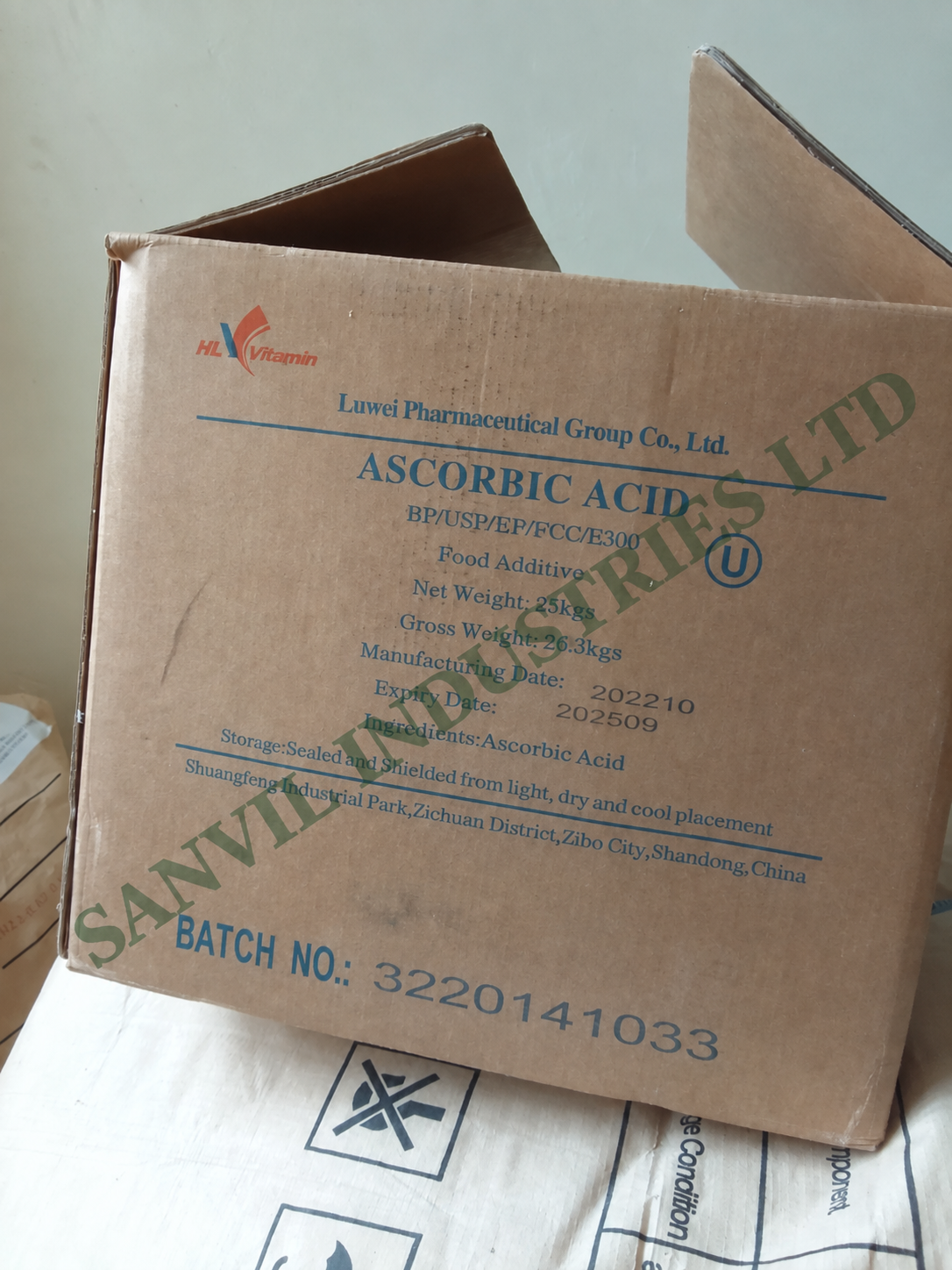
Vitamin C (Ascorbic Acid) in Kenya
| Specification | Details |
|---|---|
| Product Name | Vitamin C |
| Chemical Name | L-Ascorbic Acid |
| Alternative Name | Ascorbic Acid |
| Chemical Formula | C₆H₈O₆ |
| CAS Number | 50-81-7 |
| Molecular Weight | 176.12 g/mol |
| Food Additive Number | E300 |
| Appearance | White to slightly yellow crystalline powder |
| Odour | Essentially odourless |
| Solubility | Soluble in water |
| Grade | Food / Pharmaceutical / Feed / Industrial, specification dependent |
| Function | Vitamin ingredient / Antioxidant |
Description
Vitamin C (Ascorbic Acid) in Kenya | Sanvil Industries Ltd
Vitamin C, also known as Ascorbic Acid, is a widely used water-soluble ingredient applied in food and beverage manufacturing, dietary supplements, pharmaceutical formulations, cosmetics, personal care products, animal nutrition, and other specialty formulations. At Sanvil Industries Ltd, we supply quality Vitamin C in Kenya and serve customers across Uganda and Tanzania at competitive wholesale and bulk prices, providing reliable availability for manufacturers, processors, distributors, and commercial users.
Product Description – Vitamin C
Vitamin C, chemically known as L-Ascorbic Acid, is an organic compound with the molecular formula C₆H₈O₆. Commercial material typically appears as a white to slightly yellow crystalline powder and dissolves readily in water.
In food manufacturing, Ascorbic Acid is identified as E300 and is used as an antioxidant and processing ingredient in suitable formulations. Beverage manufacturers also use food-grade material in juices, drink mixes, and other fortified products.
Pharmaceutical and supplement manufacturers use appropriately specified grades in tablets, capsules, powders, syrups, and nutritional formulations. Cosmetic manufacturers may incorporate suitable forms into professionally developed skincare and personal-care products.
Because the ingredient can be sensitive to heat, light, oxygen, and moisture, proper packaging and storage help maintain product quality.
Sanvil Industries Ltd supplies suitable grades for food processing, beverage production, supplements, pharmaceuticals, cosmetics, animal nutrition, and commercial manufacturing throughout East Africa.
Applications of Vitamin C
1. Food Manufacturing
Food processors use E300 as an antioxidant and processing ingredient in suitable commercial food formulations.
2. Beverage Production
Manufacturers incorporate food-grade Ascorbic Acid into fruit drinks, juices, powdered beverages, and other appropriately formulated products.
3. Dietary Supplements
Supplement manufacturers use suitable grades in tablets, capsules, powders, sachets, and other nutritional products.
4. Pharmaceutical Manufacturing
Appropriately specified material serves as an active or formulation ingredient in selected pharmaceutical preparations.
5. Bakery Products
Food manufacturers may use the compound in suitable bakery formulations, including applications related to flour and dough processing.
6. Fruit and Vegetable Processing
Food processors use appropriate concentrations in selected fruit and vegetable products where antioxidant functionality is required.
7. Cosmetic Manufacturing
Cosmetic manufacturers use suitable grades or derivatives in professionally formulated skincare and personal-care products.
8. Animal Nutrition
Feed manufacturers may incorporate appropriately specified Vitamin C into selected animal nutrition products according to formulation and regulatory requirements.
9. Fortified Foods
Manufacturers add the vitamin to suitable fortified foods and nutritional products to achieve their intended formulation specifications.
10. Specialty Formulations
The compound serves as an antioxidant, reducing agent, nutritional ingredient, or formulation component in various specialized commercial applications.
Key Features & Benefits of Vitamin C
1. Antioxidant Properties
Ascorbic Acid provides antioxidant functionality in many suitable food and manufacturing applications.
2. High Water Solubility
The crystalline powder dissolves readily in water, making it convenient for many aqueous formulations.
3. Multiple Commercial Applications
Manufacturers use it across food, beverage, pharmaceutical, nutritional, cosmetic, and feed industries.
4. Food Additive E300
Food-grade Ascorbic Acid is internationally recognized as the food additive E300.
5. Convenient Powder Form
Its dry crystalline form supports accurate weighing, blending, packaging, and commercial processing.
6. Suitable for Fortification
Appropriate food-grade material can be incorporated into professionally formulated fortified foods and beverages.
7. Multiple Grades Available
Different specifications can meet the requirements of food, pharmaceutical, feed, and other manufacturing applications.
8. Reliable Bulk Supply
Sanvil Industries Ltd supports regular and bulk requirements for manufacturers, processors, distributors, and other commercial customers.
Technical Data Sheet (TDS)
| Parameter | Typical Information |
|---|---|
| Product | Vitamin C / Ascorbic Acid |
| Chemical Name | L-Ascorbic Acid |
| Formula | C₆H₈O₆ |
| CAS Number | 50-81-7 |
| Molecular Weight | 176.12 g/mol |
| Food Additive Number | E300 |
| Appearance | White to slightly yellow crystalline powder |
| Odour | Essentially odourless |
| Solubility | Soluble in water |
| Assay | Grade/manufacturer dependent |
| Grade | Food / Pharmaceutical / Feed / Industrial |
| Storage | Cool, dry, protected from light and moisture |
Why Choose Sanvil Industries Ltd
Reliable Product Quality
We supply suitable specifications for food, beverage, pharmaceutical, nutritional, cosmetic, and commercial manufacturing applications.
Competitive Wholesale Pricing
Customers can request competitive quotations according to required grade, packaging, and quantity.
Food & Industrial Requirements
Different specifications may be available according to the customer’s intended application.
Bulk Quantities Available
We support manufacturers, food processors, beverage companies, wholesalers, distributors, and other commercial users.
Technical Documentation
COA, TDS, and SDS/MSDS documentation is available upon request for applicable batches.
Flexible Packaging Options
Different packaging quantities may be supplied according to stock and customer requirements.
Regional Distribution
We serve customers throughout Kenya, Uganda, Tanzania, and other East African markets.
Responsive Customer Service
Our team assists customers with quotations, specifications, packaging requirements, and delivery enquiries.
Safety & Handling
Handle the powder using good industrial and food-hygiene practices. Avoid generating excessive airborne dust and prevent unnecessary contact with the eyes.
Store the material in tightly sealed packaging in a cool, dry place, protected from excessive heat, direct sunlight, moisture, and contamination.
Because Ascorbic Acid can oxidize during unsuitable storage, minimizing exposure to air, light, heat, and moisture helps preserve product quality.
Food, pharmaceutical, cosmetic, and feed manufacturers should use the appropriate grade and comply with applicable regulatory and formulation requirements.
Always refer to the current COA, TDS, and SDS/MSDS for the specific supplied batch.
FAQs
Q1. What is Vitamin C?
A: Vitamin C is a water-soluble vitamin chemically known as L-Ascorbic Acid, with the molecular formula C₆H₈O₆.
Q2. Is Ascorbic Acid the same as Vitamin C?
A: L-Ascorbic Acid is the chemical form commonly referred to as Vitamin C and widely used in food, supplement, and pharmaceutical products.
Q3. What is E300?
A: E300 is the food additive designation for Ascorbic Acid when used according to applicable food regulations.
Q4. What is it used for in food manufacturing?
A: Food manufacturers use suitable grades as antioxidants, processing ingredients, and nutritional fortification ingredients.
Q5. Can it be used in beverage production?
A: Yes. Food and beverage manufacturers commonly use food-grade material in suitable juices, fruit drinks, powdered beverages, and fortified beverage formulations.
Q6. Can it be used for dietary supplements?
A: Yes. Appropriately specified grades are widely used in tablets, capsules, powders, sachets, and other supplement formulations.
Q7. Is Vitamin C soluble in water?
A: Yes. Ascorbic Acid is water soluble, making it suitable for many food, beverage, pharmaceutical, and nutritional formulations.
Q8. How should the powder be stored?
A: Keep it tightly sealed in a cool, dry environment and protect it from excessive heat, light, air, moisture, and contamination.
Q9. Can I request a COA or TDS?
A: Yes. Applicable Certificates of Analysis, Technical Data Sheets, and Safety Data Sheets can be provided upon request.
Q10. Where does Sanvil Industries Ltd supply?
A: We supply customers throughout Kenya as well as Uganda, Tanzania, and other East African markets.
Contact Us
For quotations or bulk orders in Kenya, Uganda, and Tanzania, contact Sanvil Industries Ltd for competitive prices and fast delivery.
Sanvil Industries Ltd
📍 Location: Industrial Area, Nairobi, Kenya
📞 Phone: +254 722343016
📧 Email: sanvilindustries@gmail.com


Reviews
There are no reviews yet.