
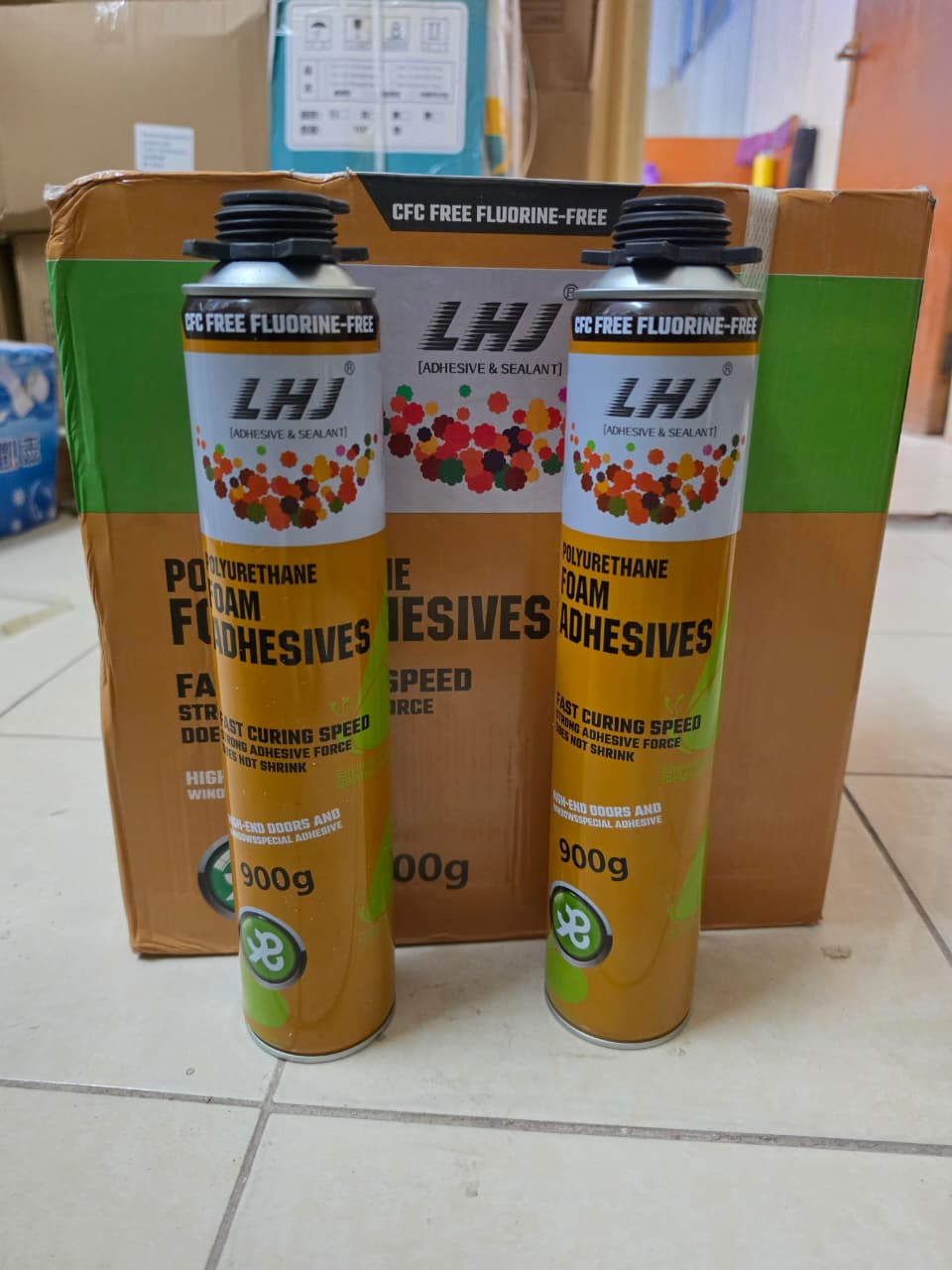
Polyurethane Foam in Kenya
| Specification | Details |
|---|---|
| Product Name | Polyurethane Foam |
| Common Name | PU Foam / Expanding Foam |
| Material Type | Polyurethane |
| Form | Expanding cellular foam |
| Common System | Single-component aerosol foam |
| Curing Mechanism | Moisture cure, product dependent |
| Appearance | Foam |
| Common Can Size | Typically 500–750 ml, product dependent |
| Application | Gap filling / Sealing / Insulation |
| Application Method | Straw or PU foam gun, product dependent |
| Expansion | Product dependent |
| Curing Time | Product dependent |
| Fire Performance | Grade dependent |
| Packaging | Pressurized aerosol can |
Description
Polyurethane Foam in Kenya | Sanvil Industries Ltd
Polyurethane Foam, commonly known as PU Foam, Expanding Foam, or Spray PU Foam, is a versatile expanding sealant and insulation material for filling gaps, sealing joints, reducing air leakage, and insulating spaces around building and industrial installations. It is widely applied in doors and windows, HVAC systems, cold rooms, refrigeration, roofing, plumbing penetrations, construction joints, wall gaps, electrical installations, and general maintenance.
At Sanvil Industries Ltd, we supply quality Polyurethane Foam in Kenya for construction, HVAC, refrigeration, fabrication, maintenance, and insulation applications. We serve contractors, technicians, factories, cold-room installers, builders, workshops, and industrial customers across Kenya, Uganda, and Tanzania at competitive wholesale and bulk prices.
Product Description – Polyurethane Foam
Polyurethane expanding foam is commonly available as a single-component moisture-curing foam in a pressurized aerosol can.
After application, the foam expands and fills irregular spaces before curing into a lightweight cellular structure. This property makes PU foam particularly useful in areas where conventional solid insulation or sealants cannot easily fill the complete cavity.
Common functions include:
- Gap filling
- Thermal insulation
- Air sealing
- Joint filling
- Cavity filling
- Draft reduction
- Installation support
- Sound reduction
- Penetration sealing
- General construction maintenance
PU foam is available in different formulations. Therefore, expansion rate, yield, density, curing time, temperature resistance, fire performance, and application method vary by manufacturer and grade.
How Polyurethane Foam Works
A typical application follows this sequence:
PU Foam Can → Application Nozzle/Gun → Foam Expansion → Gap Filling → Curing → Solid Cellular Foam
The material expands after it leaves the container. As a result, a relatively small amount of liquid formulation can fill a larger cavity.
Expansion characteristics vary considerably between products, so follow the manufacturer’s application instructions.
Applications of Polyurethane Foam
1. Door & Window Installation
PU foam fills suitable gaps between frames and surrounding walls, helping reduce air leakage around doors and windows.
2. HVAC Installations
Technicians apply expanding foam around suitable duct, pipe, cable, and service penetrations where sealing and insulation are necessary.
3. Cold Rooms
Suitable polyurethane foam helps fill small gaps and joints around cold-room panels, pipe penetrations, frames, and refrigeration installations.
4. Refrigeration Systems
PU foam can fill suitable cavities around refrigeration pipework, wall penetrations, and insulation interfaces.
5. Construction
Builders apply expanding foam to suitable cracks, cavities, joints, and spaces in construction work.
6. Roofing
Suitable PU foam can fill gaps and cavities around selected roofing and building components.
7. Plumbing Penetrations
The foam can seal suitable spaces around pipes that pass through walls, floors, cabinets, and other building components.
8. Electrical Installations
Suitable formulations can fill non-critical gaps around cable and conduit penetrations where the installation specification permits.
9. Sound Reduction
The cellular structure can help reduce some sound transmission through gaps and cavities, although ordinary PU foam is not a complete acoustic-isolation system.
10. General Maintenance
Maintenance teams use expanding foam for gap filling, sealing, insulation, and suitable repair work in buildings and industrial facilities.
Key Features & Benefits of Polyurethane Foam
1. Excellent Gap Filling
Expansion allows the foam to reach irregular cavities and spaces.
2. Thermal Insulation
The cellular structure can help reduce heat transfer through suitable gaps and cavities.
3. Air Sealing
PU foam can help reduce unwanted air movement around frames, penetrations, and joints.
4. Strong Adhesion
Suitable formulations adhere to many common construction materials when surfaces and application conditions meet manufacturer requirements.
5. Easy Application
Aerosol cans allow convenient application using a straw or compatible foam gun.
6. Lightweight Material
The foam creates a low-weight cellular structure after curing.
7. Broad Application Range
PU foam serves construction, HVAC, refrigeration, cold-room, plumbing, and general maintenance work.
8. Competitive Pricing & Reliable Supply
Sanvil Industries Ltd offers competitive wholesale and bulk pricing for contractors, installers, factories, technicians, and distributors.
Polyurethane Foam for Cold Rooms
Cold-room installations require careful control of unwanted heat and air movement.
Suitable PU foam can help fill small spaces around:
- Cold-room panel joints
- Refrigeration pipe penetrations
- Cable penetrations
- Door frames
- Wall interfaces
- Service openings
- Insulation gaps
However, aerosol PU foam should not automatically replace the primary insulation system of a cold room. Panel insulation, vapor control, joint design, sealants, and refrigeration engineering remain important.
PU Foam for HVAC Systems
HVAC technicians can use suitable expanding foam around:
- Pipe penetrations
- Duct penetrations
- Wall openings
- Cable openings
- Air-conditioning pipe routes
- Service openings
The material helps close irregular gaps where air leakage can occur.
For fire-rated walls, shafts, floors, or compartment boundaries, ordinary PU foam should not automatically replace a certified firestop system.
PU Foam for Doors & Windows
One of the most common applications is filling the installation gap between a frame and the surrounding wall.
The foam can help with:
- Gap filling
- Air sealing
- Draft reduction
- Thermal insulation
- Installation finishing
Excessive expansion can put pressure on some frames. Therefore, apply the product according to the manufacturer’s instructions and use suitable frame support during installation.
Gun Grade vs Straw Grade PU Foam
| Feature | Gun Grade | Straw Grade |
|---|---|---|
| Application | PU foam gun | Applicator straw/nozzle |
| Control | Generally higher | Basic |
| Repetitive Work | Excellent | Better for occasional work |
| Professional Installation | Common | Common |
| Application Speed | High | Application dependent |
| Equipment | Foam gun necessary | Usually no separate gun |
Standard PU Foam vs Fire-Retardant PU Foam
| Feature | Standard PU Foam | Fire-Retardant PU Foam |
|---|---|---|
| Gap Filling | Yes | Yes |
| Thermal Insulation | Yes | Yes |
| General Construction | Excellent | Excellent |
| Fire Performance | Product dependent | Formulation targets improved fire performance |
| Fire Rating | Do not assume | Certification dependent |
| Firestop Application | Not automatic | Only where the certified system permits |
A product labelled fire retardant is not automatically “fireproof.”
Fire resistance depends on the complete tested system, including substrate, joint dimensions, foam depth, backing material, installation method, and applicable certification.
Never claim a specific 60-minute, 120-minute, or 240-minute fire rating unless the exact product and installation system have valid test documentation.
Surfaces
Depending on formulation and surface preparation, polyurethane foam can adhere to many materials such as:
- Concrete
- Masonry
- Brick
- Wood
- Metal
- PVC
- Plaster
- Selected plastics
Some surfaces can require preparation, and certain plastics or contaminated surfaces may provide poor adhesion.
Always check the manufacturer’s instructions for the actual product.
Expansion
PU foam expands after application.
There are generally products with different expansion characteristics, including formulations for controlled or lower expansion.
Higher expansion is not automatically better. Door frames, window frames, delicate panels, and narrow joints can require controlled application to avoid excessive pressure.
Curing
Many one-component PU foams cure through interaction with atmospheric moisture.
Curing speed depends on factors such as:
- Temperature
- Humidity
- Joint depth
- Foam quantity
- Product formulation
The outer surface normally firms before the internal foam reaches full cure.
Follow the manufacturer’s technical instructions before cutting, trimming, loading, coating, or covering the material.
Trimming & Finishing
After sufficient cure, excess foam can normally be trimmed according to product instructions.
Where exposure to sunlight occurs, cured PU foam may require suitable protection because prolonged UV exposure can degrade many polyurethane foams.
Finishing can involve a compatible:
- Sealant
- Paint
- Plaster
- Cover strip
- Cladding
- Protective coating
Compatibility should be checked first.
PU Foam Accessories
Useful accessories can include:
- PU foam guns
- Applicator nozzles
- Foam gun cleaner
- Protective gloves
- Safety glasses
- Cutting tools
- Suitable sealants
- Insulation materials
Professional users who apply large quantities often prefer gun-grade foam because it can provide greater application control.
Technical Data Sheet (TDS)
| Parameter | Typical Information |
|---|---|
| Product | Polyurethane Expanding Foam |
| Material | Polyurethane |
| Form | Expanding foam |
| System | Commonly one-component |
| Cure | Moisture cure, product dependent |
| Colour | Product dependent |
| Can Volume | Typically 500–750 ml |
| Application | Straw / Foam Gun |
| Expansion | Manufacturer dependent |
| Tack-Free Time | Manufacturer dependent |
| Full Cure | Manufacturer dependent |
| Density | Manufacturer dependent |
| Thermal Conductivity | Manufacturer dependent |
| Temperature Resistance | Manufacturer dependent |
| Fire Classification | Product/certification dependent |
| Storage | Follow manufacturer instructions |
Why Choose Sanvil Industries Ltd
Quality PU Foam
We stock polyurethane expanding foam for professional construction, HVAC, refrigeration, and maintenance applications.
Construction & Industrial Applications
Our products serve builders, cold-room installers, HVAC technicians, refrigeration companies, factories, and maintenance teams.
PU Foam Accessories
Customers can also enquire about compatible foam guns, cleaners, insulation products, sealants, and related installation materials.
Standard & Specialized Options
Different foam formulations can suit general gap filling and more specialized requirements, subject to availability.
Competitive Wholesale Pricing
Sanvil Industries Ltd provides competitive prices for individual, wholesale, project, and bulk requirements.
Technical Documentation
TDS and SDS documentation can be available upon request for applicable products and batches.
Regional Distribution
We supply customers across Kenya, Uganda, Tanzania, and other East African markets.
Bulk Order Support
Contractors, construction companies, cold-room installers, HVAC companies, factories, institutions, and distributors can request bulk quotations.
Safety & Handling
Polyurethane foam aerosol cans are pressurized containers, and formulations can contain flammable propellants.
Uncured polyurethane foam formulations can also contain isocyanates and other chemicals that require careful handling.
Therefore:
- Work in a well-ventilated area.
- Keep the product away from flames, sparks, and ignition sources.
- Wear suitable gloves and eye protection.
- Avoid breathing vapour or aerosol.
- Avoid unnecessary skin contact.
- Do not puncture or burn aerosol containers.
- Protect cans from excessive heat.
- Follow the product SDS and label instructions.
- Keep away from children and unauthorized personnel.
For fire-rated construction, use only products and complete systems with suitable certification for the particular application.
FAQs
Q1. What is polyurethane foam?
A: It is an expanding polymer foam that can fill gaps, seal cavities, reduce air leakage, and provide thermal insulation.
Q2. What is PU foam for?
A: Common applications include doors, windows, HVAC systems, cold rooms, refrigeration, construction gaps, pipe openings, and general maintenance.
Q3. Can PU foam help in cold rooms?
A: Yes. Suitable foam can fill small gaps around panels, pipes, frames, cables, and service openings as part of a proper insulation system.
Q4. Can PU foam seal gaps around air-conditioning pipes?
A: Yes. Suitable formulations can fill spaces around AC pipe and service penetrations.
Q5. Does polyurethane foam expand?
A: Yes. Expansion helps the material fill irregular cavities. The exact expansion level depends on the product.
Q6. Is all PU foam fire retardant?
A: No. Standard and fire-retardant formulations differ. Check the exact product certification where fire performance matters.
Q7. Is fire-retardant PU foam fireproof?
A: No. Fire-retardant foam can offer improved fire behaviour, but the complete system and test certification determine actual performance.
Q8. Can I trim PU foam?
A: Many products allow trimming after sufficient cure. Follow the manufacturer’s instructions for the exact foam.
Q9. Can I buy polyurethane foam in bulk?
A: Yes. Sanvil Industries Ltd handles bulk orders for contractors, HVAC companies, cold-room installers, factories, builders, and distributors.
Q10. Which countries can Sanvil Industries Ltd deliver polyurethane foam to?
A: We serve customers across Kenya, Uganda, Tanzania, and other East African markets.
Contact Us
For quotations or bulk orders in Kenya, Uganda, and Tanzania, contact Sanvil Industries Ltd for competitive prices and fast delivery.
Sanvil Industries Ltd
📍 Location: Industrial Area, Nairobi, Kenya
📞 Phone: +254 722343016
📧 Email: sanvilindustries@gmail.com


Reviews
There are no reviews yet.