
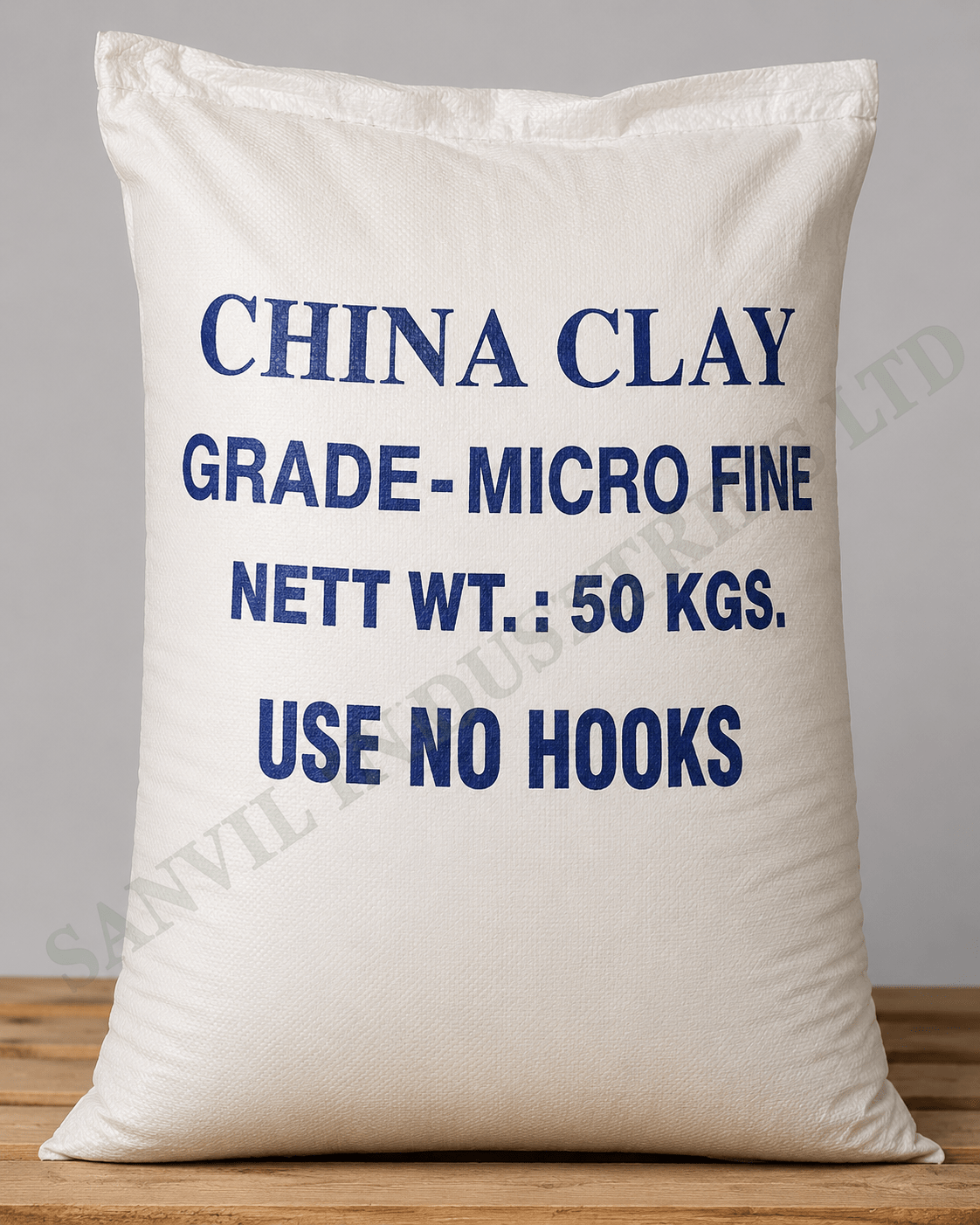
Kaolin in Kenya
| Specification | Details |
|---|---|
| Product Name | Kaolin |
| Synonyms | China Clay, Kaolinite Clay |
| Main Mineral | Kaolinite |
| Approx. Formula | Al₂Si₂O₅(OH)₄ |
| Grade | Industrial / Ceramic / Cosmetic Grade |
| Appearance | Fine white to off-white powder |
| CAS Number | 1332-58-7 |
| Odour | Odourless |
| Solubility | Insoluble in water |
| Packaging | 1 kg, 5 kg, 25 kg Bags / Bulk Supply Available |
Description
Kaolin in Kenya | Sanvil Industries Ltd
Kaolin is a versatile industrial mineral widely used in paint manufacturing, ceramics, paper production, plastics, rubber, construction materials, cosmetics, pharmaceuticals, detergents, and specialty industrial formulations. At Sanvil Industries Ltd, we supply high-quality Kaolin across Kenya, Uganda, and Tanzania at competitive wholesale and bulk prices, ensuring consistent quality, reliable performance, and dependable availability for manufacturers and commercial customers.
Product Description – Kaolin
Kaolin, commonly known as China Clay, is a naturally occurring clay mineral composed mainly of kaolinite, with the approximate chemical formula Al₂Si₂O₅(OH)₄. It typically appears as a fine white to off-white powder and is valued for its whiteness, fine particle size, chemical stability, low abrasiveness, and excellent filling properties.
Manufacturers use Kaolin as a functional filler, extender, coating mineral, reinforcing material, and processing aid. In paints and coatings, it can improve opacity, consistency, suspension, and surface properties. Ceramic manufacturers use it as an important raw material for tiles, sanitaryware, tableware, and other ceramic products.
The paper, rubber, plastics, construction, cosmetic, and detergent industries also use appropriate grades for different manufacturing requirements. At Sanvil Industries Ltd, we supply Kaolin for commercial and industrial applications, backed by competitive pricing and reliable delivery throughout East Africa.
Applications of Kaolin
1. Paint Manufacturing
Paint manufacturers use Kaolin as a functional extender and filler in emulsion paints, primers, architectural coatings, and selected industrial coatings.
2. Ceramic Manufacturing
Ceramic producers use China Clay in tiles, sanitaryware, tableware, pottery, electrical ceramics, and other ceramic products.
3. Paper Manufacturing
Paper manufacturers use suitable grades as fillers and coating pigments to improve surface properties, printability, opacity, and appearance.
4. Plastic Manufacturing
Plastic processors incorporate Kaolin as a mineral filler in selected plastic compounds to modify stiffness, dimensional stability, and processing characteristics.
5. Rubber Manufacturing
Rubber manufacturers use the mineral as a filler and processing ingredient in suitable rubber compounds.
6. Construction Materials
Building-material manufacturers use Kaolin in selected cementitious products, coatings, putties, boards, and construction formulations.
7. Cosmetic Manufacturing
Appropriate cosmetic-grade material is used in facial masks, powders, soaps, cleansers, and other personal care formulations.
8. Pharmaceutical Applications
Pharmaceutical manufacturers use suitable pharmaceutical-grade Kaolin in selected formulations and manufacturing processes. Always select the appropriate grade according to the required product specification.
9. Detergent and Soap Manufacturing
Manufacturers use appropriate grades as fillers and functional mineral ingredients in selected soaps and cleaning products.
10. Adhesives and Sealants
Kaolin can function as a filler and rheology-modifying mineral in selected adhesive, sealant, and compound formulations.
Key Features & Benefits of Kaolin
1. Fine Particle Size
Its fine particles support smooth dispersion and consistent performance in suitable formulations.
2. Good Whiteness
Selected high-whiteness grades are particularly valuable in paints, coatings, paper, ceramics, and plastics.
3. Excellent Filling Properties
Acts as an economical functional filler in numerous industrial formulations.
4. Low Abrasiveness
Suitable grades provide useful filling performance without excessive abrasion of processing equipment.
5. Chemical Stability
Kaolin remains relatively stable under many normal manufacturing and processing conditions.
6. Good Surface Properties
Can contribute to smoothness, consistency, opacity, and finish in coatings and other suitable formulations.
7. Wide Industrial Applications
Useful across paints, ceramics, paper, plastics, rubber, construction, cosmetics, and detergents.
8. Competitive Pricing & Reliable Supply
Sanvil Industries Ltd provides competitive wholesale and bulk prices with dependable supply throughout East Africa.
Technical Data Sheet (TDS)
| Parameter | Typical Information |
|---|---|
| Product Name | Kaolin |
| Main Mineral | Kaolinite |
| Approx. Formula | Al₂Si₂O₅(OH)₄ |
| CAS Number | 1332-58-7 |
| Appearance | Fine white/off-white powder |
| Odour | Odourless |
| Solubility | Insoluble in water |
| Particle Size | Grade dependent |
| Whiteness | Grade dependent |
| Grade | Industrial / Ceramic / Cosmetic |
| Packaging | 1 kg, 5 kg, 25 kg / Bulk |
Whiteness, particle-size distribution, moisture, pH, brightness, chemical composition, and other properties vary considerably by grade and source. Request the current COA or technical data sheet for exact specifications.
Why Choose Sanvil Industries Ltd
- Trusted supplier of industrial minerals and chemical raw materials.
- Different Kaolin grades available depending on application requirements.
- Competitive wholesale and bulk prices.
- Reliable supply for manufacturers and distributors.
- COA and SDS/MSDS available upon request.
- Fast delivery across Kenya, Uganda, and Tanzania.
- Support when selecting the appropriate grade and particle specification.
- Prompt quotations for commercial and bulk requirements.
FAQs
Q1. What is Kaolin mainly used for?
A: Kaolin is widely used in paints, ceramics, paper, plastics, rubber, construction materials, cosmetics, detergents, adhesives, and other industrial formulations.
Q2. Is Kaolin the same as China Clay?
A: China Clay is a common commercial name for Kaolin, a clay material composed predominantly of the mineral kaolinite.
Q3. What is the chemical formula of Kaolin?
A: The principal mineral kaolinite has the approximate formula Al₂Si₂O₅(OH)₄.
Q4. Why is Kaolin used in paint manufacturing?
A: It functions as a mineral extender and filler and can contribute to opacity, consistency, suspension, surface finish, and formulation economics.
Q5. Can Kaolin be used in ceramics?
A: Yes. It is an important ceramic raw material used in tiles, sanitaryware, tableware, pottery, and other ceramic products.
Q6. Is Kaolin used in cosmetics?
A: Yes. Suitable cosmetic-grade material is used in products such as facial masks, powders, soaps, and cleansers. The correct cosmetic-grade specification should always be selected.
Q7. Is Kaolin soluble in water?
A: No. Kaolin is essentially insoluble in water but can be dispersed in suitable water-based formulations.
Q8. What packaging sizes are available?
A: We supply 1 kg, 5 kg, 25 kg bags, and bulk quantities, depending on customer requirements and availability.
Q9. Are COA and SDS/MSDS available?
A: Yes. Certificates of Analysis and Safety Data Sheets are available upon request for applicable product batches.
Q10. Which countries does Sanvil Industries Ltd supply?
A: We supply Kaolin throughout Kenya, Uganda, Tanzania, and other East African markets.
Contact Us
For quotations or bulk orders in Kenya, Uganda, and Tanzania, contact Sanvil Industries Ltd for competitive prices and fast delivery.
Sanvil Industries Ltd
Location: Industrial Area, Nairobi, Kenya
Phone: +254 722343016
Email: sanvilindustries@gmail.com

Reviews
There are no reviews yet.