
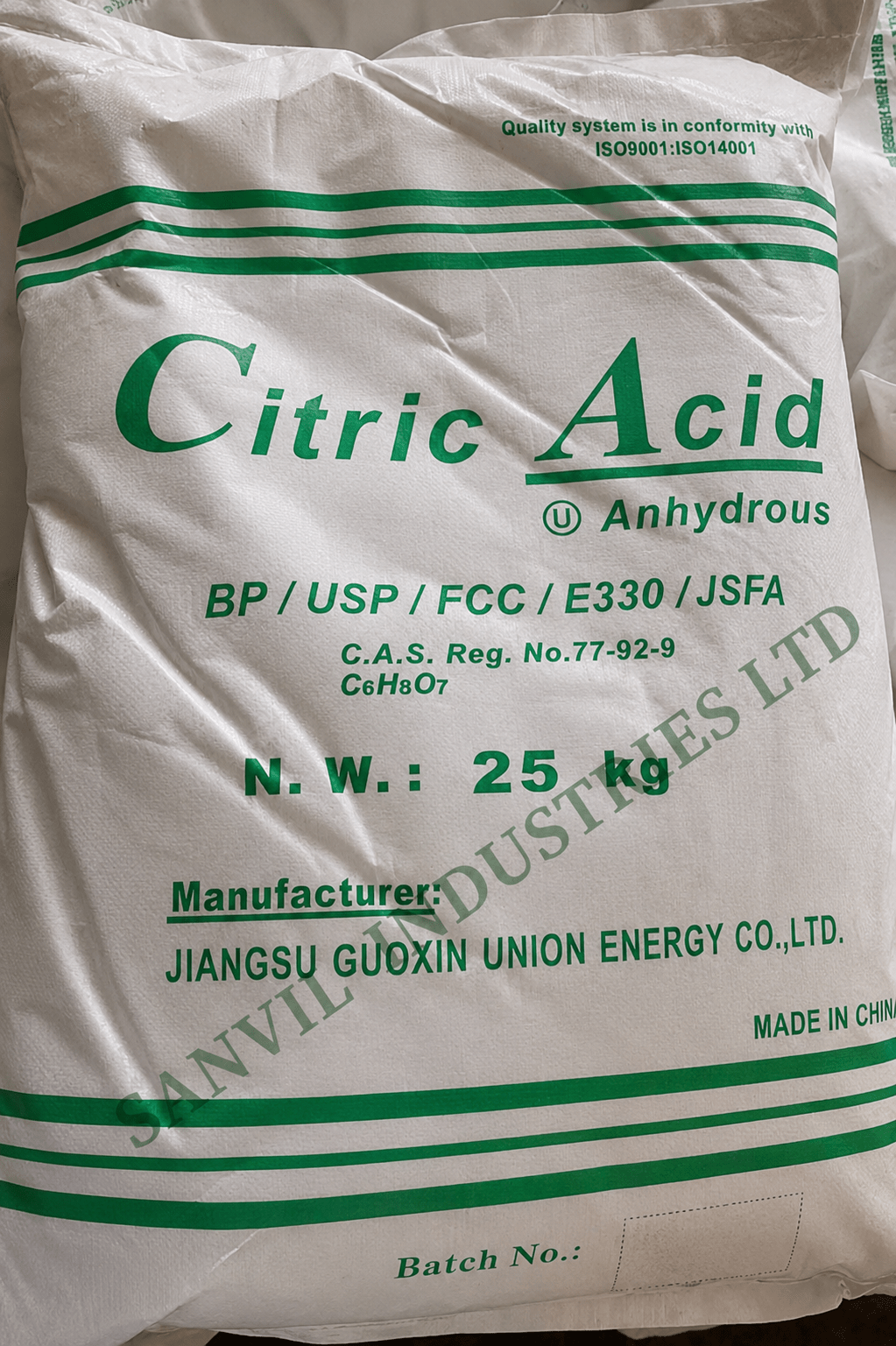
Citric Acid Anhydrous in Kenya
| Specification | Details |
|---|---|
| Product Name | Citric Acid Anhydrous |
| Synonyms | Anhydrous Citric Acid, 2-Hydroxypropane-1,2,3-Tricarboxylic Acid |
| Chemical Formula | C₆H₈O₇ |
| Food Additive Number | E330 |
| Grade | Food Grade / Pharmaceutical Grade / Industrial Grade |
| Appearance | White crystalline powder or colourless crystals |
| Purity | Typically ≥99.5% |
| CAS Number | 77-92-9 |
| Molecular Weight | 192.12 g/mol |
| Solubility | Highly soluble in water |
Description
Citric Acid Anhydrous in Kenya | Sanvil Industries Ltd
Citric Acid Anhydrous is a high-purity acidulant widely used in food and beverage processing, pharmaceuticals, cosmetics, detergents, confectionery, water treatment, cleaning products, and industrial formulations. At Sanvil Industries Ltd, we supply high-quality C₆H₈O₇ across Kenya, Uganda, and Tanzania at competitive wholesale and bulk prices, ensuring consistent purity, reliable performance, and dependable availability for manufacturers and commercial customers.
Product Description – Citric Acid Anhydrous
Citric Acid Anhydrous, with the chemical formula C₆H₈O₇, is the water-free form of citric acid. It normally appears as a white crystalline powder or colourless crystals and dissolves readily in water. Unlike Citric Acid Monohydrate, the anhydrous form contains no water of crystallization.
Food and beverage manufacturers value the product for its acidifying, flavour-enhancing, buffering, and sequestrant properties. Citric acid is identified as food additive E330 and is commonly used in beverages, confectionery, powdered drink mixes, sauces, jams, processed foods, and other permitted applications.
The pharmaceutical, cosmetic, detergent, and industrial sectors also use the compound for pH adjustment, formulation control, chelation, and cleaning applications. At Sanvil Industries Ltd, we provide suitable grades for different manufacturing requirements, backed by competitive pricing, dependable supply, and efficient delivery throughout East Africa.
Applications of Citric Acid Anhydrous
1. Beverage Manufacturing
Manufacturers use it to provide acidity and balance flavour in soft drinks, juices, energy drinks, concentrates, and powdered beverages.
2. Food Processing
Food manufacturers use E330 as an acidulant and acidity regulator in various processed food formulations.
3. Confectionery Production
Candy, gummy, jelly, and sweet manufacturers use the compound to provide a characteristic tart or sour flavour.
4. Powdered Drink Mixes
The anhydrous form is particularly useful in dry beverage powders and other low-moisture formulations.
5. Pharmaceutical Manufacturing
Pharmaceutical-grade material is used in suitable tablets, powders, syrups, and effervescent formulations.
6. Cosmetic Manufacturing
Cosmetic manufacturers use the compound for pH adjustment in suitable creams, lotions, shampoos, cleansers, and personal care formulations.
7. Detergent Manufacturing
Detergent manufacturers use it as a chelating ingredient, builder, and pH-control agent in selected cleaning formulations.
8. Descaling Products
Its acidic and chelating properties make it useful in formulated products designed to remove mineral deposits and scale.
9. Water Treatment
Suitable industrial grades can support pH adjustment and selected water-treatment processes.
10. Industrial Chemical Formulations
Chemical manufacturers use C₆H₈O₇ as an acidifying, buffering, and chelating ingredient in numerous specialty formulations.
Key Features & Benefits of Citric Acid Anhydrous
1. High Purity
High-quality grades provide dependable performance across food, pharmaceutical, cosmetic, and industrial applications.
2. Water-Free Form
Contains no water of crystallization, making it particularly useful in dry and powdered formulations.
3. Effective Acidity Regulation
Helps manufacturers achieve the required acidity and pH in suitable products.
4. Excellent Water Solubility
Dissolves readily for convenient incorporation into manufacturing processes.
5. Flavour Enhancement
Provides the clean, tart acidic profile required in many foods, beverages, and confectionery products.
6. Chelating Properties
Helps bind certain metal ions, supporting its use in cleaning, detergent, and industrial formulations.
7. Wide Range of Applications
Suitable grades serve food, beverage, pharmaceutical, cosmetic, detergent, water-treatment, and chemical industries.
8. Competitive Pricing & Reliable Supply
Sanvil Industries Ltd provides competitive wholesale and bulk prices with dependable supply throughout East Africa.
Technical Data Sheet (TDS)
| Parameter | Typical Information |
|---|---|
| Chemical Name | Citric Acid Anhydrous |
| Chemical Formula | C₆H₈O₇ |
| CAS Number | 77-92-9 |
| Molecular Weight | 192.12 g/mol |
| Appearance | White crystalline powder/crystals |
| Assay | Typically ≥99.5% |
| Solubility | Highly soluble in water |
| Food Additive Number | E330 |
| Grade | Food / Pharmaceutical / Industrial |
Why Choose Sanvil Industries Ltd
- Trusted supplier of food, pharmaceutical, and industrial ingredients.
- Quality Citric Acid Anhydrous for different manufacturing applications.
- Competitive wholesale and bulk pricing.
- Reliable stock availability for manufacturers and distributors.
- COA and SDS/MSDS available upon request.
- Fast delivery across Kenya, Uganda, and Tanzania.
- Assistance in selecting the appropriate grade and specification.
- Prompt quotations for commercial and bulk orders.
FAQs
Q1. What is Citric Acid Anhydrous mainly used for?
A: It is widely used in food, beverages, confectionery, pharmaceuticals, cosmetics, detergents, cleaning products, water treatment, and industrial formulations.
Q2. What is the chemical formula of Citric Acid Anhydrous?
A: Its chemical formula is C₆H₈O₇, with a molecular weight of approximately 192.12 g/mol.
Q3. What does E330 mean?
A: E330 is the food additive designation for citric acid, which is used as an acidulant and acidity regulator in permitted food applications.
Q4. Can Citric Acid Anhydrous be used in beverages?
A: Yes. Food-grade material is widely used to regulate acidity and enhance flavour in soft drinks, juices, energy drinks, concentrates, and powdered beverages.
Q5. Is it suitable for confectionery?
A: Yes. Manufacturers use it in candies, gummies, jellies, and other confectionery products to create a tart or sour flavour profile.
Q6. What is the difference between Citric Acid Anhydrous and Monohydrate?
A: The anhydrous form contains no water of crystallization, while the monohydrate form contains one water molecule per citric acid molecule. This difference affects molecular weight and suitability for certain formulations.
Q7. Can Citric Acid Anhydrous be used for descaling?
A: Yes. It is used in properly formulated cleaning and descaling products because its acidic and chelating properties can help remove mineral deposits.
Q8. How should Citric Acid Anhydrous be stored?
A: Store it in tightly sealed packaging in a cool, dry place protected from moisture, contamination, and direct sunlight.
Q9. Are COA and SDS/MSDS available?
A: Yes. Certificates of Analysis and Safety Data Sheets are available upon request for applicable product batches.
Q10. Which countries does Sanvil Industries Ltd supply?
A: We supply Citric Acid Anhydrous throughout Kenya, Uganda, Tanzania, and other East African markets.
Contact Us
For quotations or bulk orders in Kenya, Uganda, and Tanzania, contact Sanvil Industries Ltd for competitive prices and fast delivery.
Sanvil Industries Ltd
Location: Industrial Area, Nairobi, Kenya
Phone: +254 722343016
Email: sanvilindustries@gmail.com


Reviews
There are no reviews yet.